AI successfully guides free-flying robot on the ISS in first-of-its-kind autonomous navigation test
 13 oC
13 oC 
Güneşli

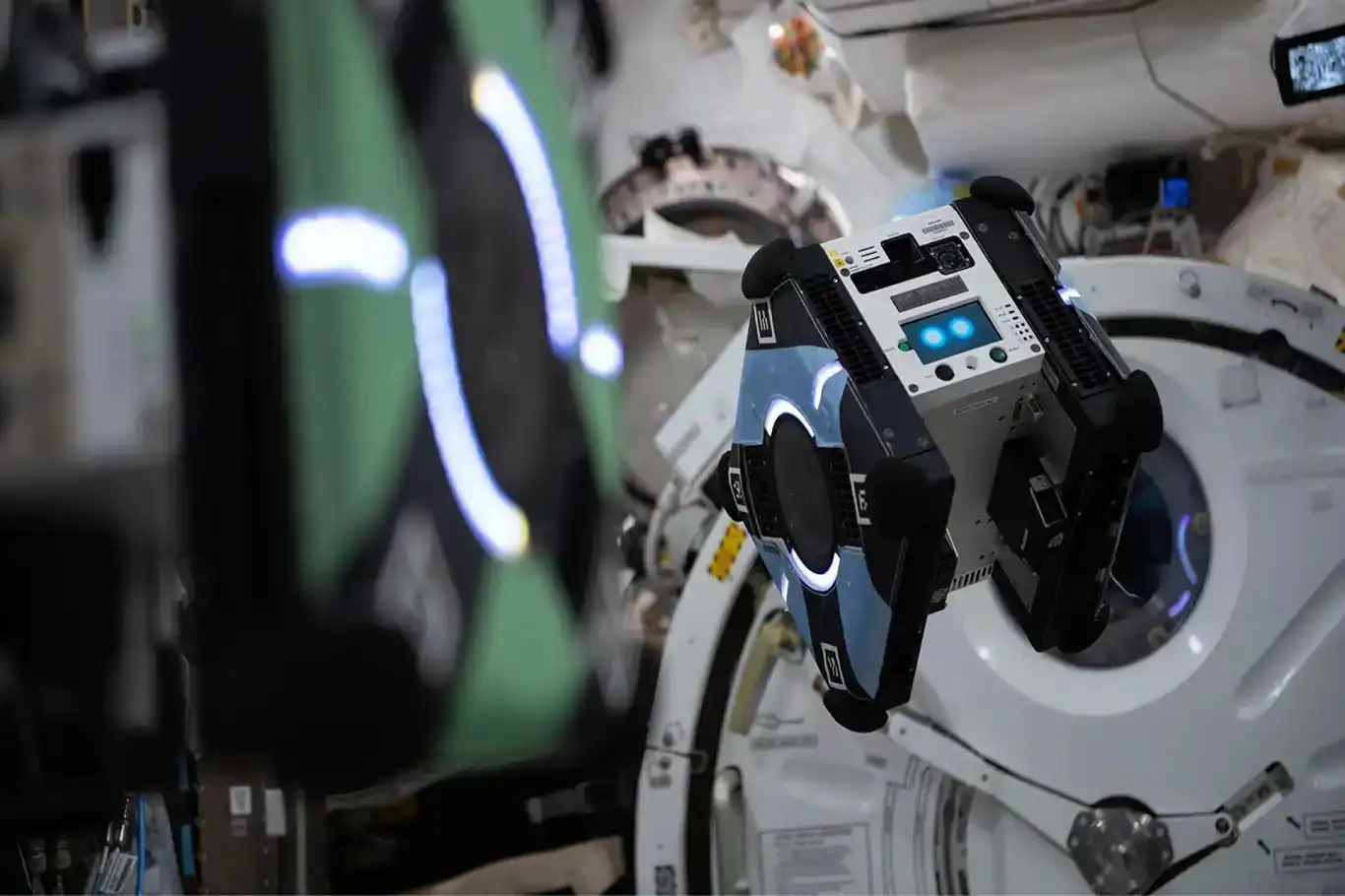
Artificial intelligence has, for the first time, been used to autonomously guide a free-flying robot aboard the International Space Station, marking a significant breakthrough in space robotics and autonomous mission operations.
The achievement, realized through collaboration between Stanford University researchers and NASA engineers, is expected to accelerate the development of self-governing robotic systems for future missions to the Moon, Mars, and deep space.
The experiment centered on Astrobee, NASA’s cube-shaped free-flying robot designed to assist astronauts with routine tasks in microgravity. While Astrobee has flown numerous missions under manual or preprogrammed control, maneuvering autonomously inside the narrow, equipment-filled modules of the ISS has long posed severe technical challenges. Microgravity disrupts conventional motion-planning models, and radiation-hardened onboard computers have limited computational capacity compared to Earth-based robots.
Stanford’s research team sought to overcome these constraints using a hybrid planning system that pairs classical optimization methods with an AI model trained on thousands of precomputed trajectories. This AI-powered “informed initialization” allowed the robot to approach each new task with a starting point based on learned experience, rather than computing an optimal route from scratch.
Lead researcher and Stanford PhD candidate Somrita Banerjee described the approach as enabling the robot to “plan like humans navigate city streets,” combining known pathways with real-time adjustments. By narrowing the solution space before optimization begins, the system dramatically reduces processing time while maintaining strict safety requirements.
Before entering orbit, the system underwent validation at NASA’s Ames Research Center on a granite testbed designed to mimic microgravity motions. After successful ground verification, authorities approved on-station testing under NASA’s minimum-crew experiment protocol.
During the four-hour session aboard the ISS, flight controllers at the Johnson Space Center commanded Astrobee through 18 separate flight paths. Each route was executed twice: once with traditional planning and once with the AI-enhanced initialization. Data showed that AI-supported routes were calculated 50 to 60 percent faster while maintaining collision avoidance and responding safely to real-time contingencies. Virtual safety barriers and emergency stop commands remained active as additional protective layers.
Banerjee emphasized that this demonstration represents “the first direct contribution of an AI model to the real-time control of a robot aboard the ISS,” calling it a critical step toward safe and scalable autonomy in space. She noted that as missions extend farther from Earth, continuous ground control becomes impractical. “Robots will need to make fast, informed decisions on their own. Safe autonomy is no longer optional; it is essential.”
Researchers believe this technology could eventually allow orbital and planetary robots to independently manage inspection tasks, cargo movements, environmental monitoring, and scientific experiments. Such capabilities would free astronauts to focus on mission-critical activities and reduce operational burdens on mission control.
NASA and Stanford are preparing additional test campaigns to evaluate performance under more complex station layouts and dynamic conditions. If further trials confirm reliability, AI-augmented autonomy may become a baseline requirement for the next generation of space robotics, shaping human and robotic operations in low Earth orbit and beyond.(ILKHA)
LEGAL WARNING: All rights of the published news, photos and videos are reserved by İlke Haber Ajansı Basın Yayın San. Trade A.Ş. Under no circumstances can all or part of the news, photos and videos be used without a written contract or subscription.
China successfully placed nine satellites into orbit aboard its Lijian-1 (Kinetica-1 Y11) carrier rocket, including an Earth-observation satellite developed under the leadership of the United Arab Emirates (UAE).

A major new study by the Oxford Internet Institute and the AI Security Institute has revealed that conversational artificial intelligence systems can significantly influence people’s political beliefs, raising serious concerns about the future of democratic processes and election integrity.

The European Commission has imposed a €120 million fine on X (formerly Twitter) for multiple violations of the Digital Services Act (DSA), marking the first non-compliance decision issued under the landmark EU regulation.