Türkiye’s AI model Cosmos T1 outperforms larger global models in Turkish math reasoning
 13 oC
13 oC 
Güneşli

A domestically developed artificial intelligence model in Türkiye has achieved a major milestone in Turkish-language mathematical reasoning, outperforming significantly larger international systems in benchmark testing.
Cosmos T1, a 9-billion-parameter AI model developed by the Cosmos research team at Yıldız Technical University (YTU), reached a 77.41% accuracy rate on the GSM8K benchmark, a widely used test that measures mathematical reasoning capabilities in large language models.
According to the research team, the model demonstrated superior performance compared to substantially larger systems, including Meta’s 70-billion-parameter Llama-3.1-70B, which recorded 66.13% accuracy, and Google’s Gemma-2-9B model, which achieved 63.10% accuracy on the same test.
The results indicate that Cosmos T1 is capable of competing with models nearly eight times its size in parameter count, particularly in Turkish-language reasoning tasks.
The project was led by Prof. Dr. Mehmet Fatih Amasyalı of YTU’s Department of Computer Engineering and the Department of Artificial Intelligence and Data Engineering. Researchers stated that Cosmos T1 distinguishes itself through advanced Turkish-language “chain-of-thought” reasoning, enabling the model to articulate intermediate reasoning steps before generating final answers.
Amasyalı noted that the model was developed based on Google’s Gemma 2 architecture, with extensive enhancements focused on Turkish linguistic performance. Unlike conventional question-answer systems that generate direct outputs, Cosmos T1 operates in a two-stage process: structured reasoning followed by answer generation.
The model has been released as open-weight, allowing institutions and companies to download and deploy it on-premise. This approach is considered particularly valuable for sectors with strict data governance requirements, such as healthcare and defense, where external data sharing may be restricted.
Users can access Cosmos T1 either through an online platform or by integrating the downloadable model weights into their own infrastructure. The development process was supported under TÜBİTAK-funded research projects, including financial backing for Turkish-language optimization.
Researchers stated that the model underwent intensive training to transition from a conventional “non-reasoning” architecture to a reasoning-enabled system, a transformation that significantly improved its performance. The achievement has also generated considerable attention on social media platforms.
The advancement marks a notable step in Türkiye’s expanding AI ecosystem and highlights the growing role of localized language optimization in global AI competitiveness.(ILKHA)
LEGAL WARNING: All rights of the published news, photos and videos are reserved by İlke Haber Ajansı Basın Yayın San. Trade A.Ş. Under no circumstances can all or part of the news, photos and videos be used without a written contract or subscription.

The Australian government announced on Saturday that it will significantly strengthen its landmark social media minimum age law by doubling the maximum penalty for non-compliant platforms to $99 million.
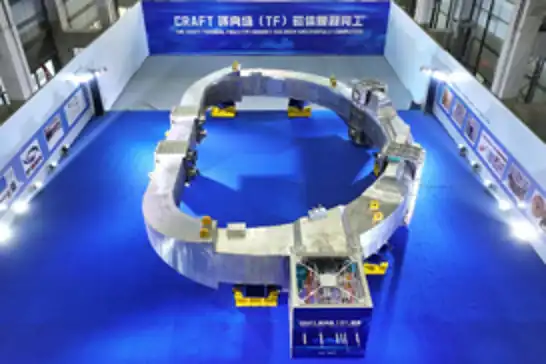
China has announced a significant advance in its quest to develop fusion energy, often described as the "holy grail" of clean power generation, after successfully completing development and testing of two critical superconducting magnet systems for a next-generation fusion reactor.
Chinese researchers have developed a ceramic-based lithium-ion microbattery capable of operating under extreme temperatures, a breakthrough that could expand the use of energy storage systems in harsh environments.

Oracle has cut around 21,000 jobs as part of a broad restructuring effort linked in part to the company’s increasing use of artificial intelligence technologies, according to its latest annual regulatory filing.