China achieves major breakthrough in fusion energy with record-breaking superconducting magnets
 13 oC
13 oC 
Güneşli

China has announced a significant advance in its quest to develop fusion energy, often described as the "holy grail" of clean power generation, after successfully completing development and testing of two critical superconducting magnet systems for a next-generation fusion reactor.
The achievement was announced on Saturday by the Institute of Plasma Physics under the Chinese Academy of Sciences, marking another milestone in China's ambitious effort to build an "artificial sun" capable of producing virtually limitless, carbon-free energy.
According to the institute, both the Toroidal Field (TF) superconducting magnet and a high-temperature superconducting central solenoid coil successfully passed rigorous development approval procedures and full-parameter performance tests. Researchers emphasized that the systems were developed with entirely domestic technology and manufacturing capabilities, achieving 100 percent localization of core components.
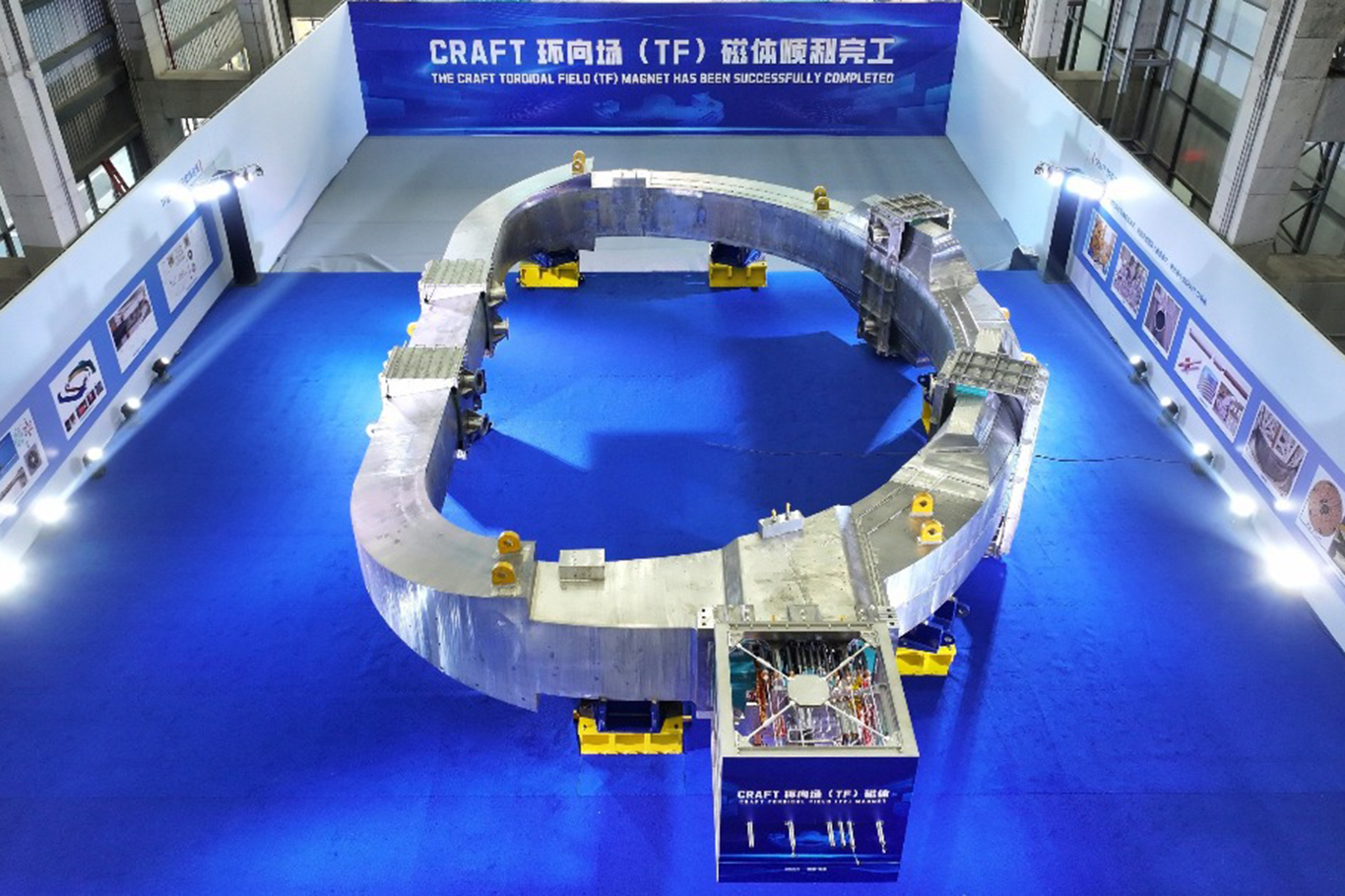
At the center of the breakthrough is the Toroidal Field superconducting magnet, which has officially become the largest magnet ever constructed for a fusion device.
The massive structure measures 21 meters in length, 12 meters in width, and 3.3 meters in height, while weighing an astonishing 582 tonnes. Scientists noted that the magnet possesses a volume approximately 1.3 times larger than the toroidal field magnets used in the international ITER fusion project and stores three times more magnetic energy.
The magnet is one of the most important components of a tokamak fusion reactor, generating the powerful magnetic fields required to confine ultra-hot plasma. Fusion reactions require temperatures exceeding 100 million degrees Celsius—several times hotter than the core of the Sun—making magnetic confinement essential for maintaining stability and sustaining energy-producing reactions.
Researchers revealed that development of the magnet required six years of intensive scientific work, engineering innovation, and testing. The project resulted in 47 authorized patents and the establishment of 14 technical standards, demonstrating significant advances in China's domestic fusion technology capabilities.
Alongside the toroidal field magnet, a high-temperature superconducting central solenoid coil also successfully completed full-load operational testing.
The system achieved stable operation at a current of 60 kiloamperes while storing 6.03 megajoules of energy. According to project scientists, its technical performance has reached world-leading levels.
The central solenoid serves as the "heart" of a fusion reactor, inducing and controlling the powerful plasma current required for fusion reactions. It also plays a crucial role in shaping and stabilizing plasma within the reactor chamber.
Together, the two superconducting systems form essential components of future fusion power facilities and represent major engineering achievements in advanced materials science, superconductivity, and plasma physics.
The breakthrough is part of China's Comprehensive Research Facility for Fusion Technology (CRAFT), a major national research program designed to accelerate the development of commercial fusion energy technologies.
The achievement further demonstrates China's growing ability to independently design and manufacture highly sophisticated scientific infrastructure. By localizing core technologies, Chinese researchers have reduced reliance on foreign suppliers while strengthening the country's position in the global race to develop practical fusion power.
China has invested heavily in fusion research over the past two decades through projects such as the Experimental Advanced Superconducting Tokamak (EAST), widely known as China's "artificial sun." EAST has repeatedly set records for sustaining high-temperature plasma, providing valuable data for future commercial fusion reactors.
Fusion energy has long been viewed as one of humanity's most promising long-term energy solutions. Unlike conventional nuclear fission reactors, fusion generates energy by combining atomic nuclei, producing enormous amounts of power without emitting greenhouse gases and with significantly less long-lived radioactive waste.
Governments and research institutions worldwide are investing billions of dollars in fusion technology. Major projects include the international ITER reactor in France, as well as national programs in China, the United States, Europe, Japan, South Korea, and Russia.
Although commercial fusion power remains years away, recent technological breakthroughs have accelerated optimism across the scientific community. Advances in superconducting materials, plasma confinement, artificial intelligence, and reactor engineering are bringing researchers closer to the goal of creating reactors capable of producing more energy than they consume.
China's latest success is widely viewed as another important step toward that objective, highlighting the country's expanding role in one of the most ambitious scientific and technological endeavors of the 21st century.
If successful, fusion energy could eventually provide a virtually limitless source of clean electricity, helping nations meet growing energy demands while reducing dependence on fossil fuels and supporting global climate goals. (ILKHA)
LEGAL WARNING: All rights of the published news, photos and videos are reserved by İlke Haber Ajansı Basın Yayın San. Trade A.Ş. Under no circumstances can all or part of the news, photos and videos be used without a written contract or subscription.

Microsoft has introduced a new voluntary exit program covering approximately 60,000 employees across the United States, Canada, the United Kingdom and India, expanding its workforce-reduction options following thousands of job cuts and a voluntary retirement initiative earlier this year.
China launched a Long March 8A carrier rocket from the southern island province of Hainan on Sunday, successfully placing a new batch of low-orbit internet satellites into their designated orbit.

A federal judge in New Mexico has ordered Meta, the parent company of Facebook and Instagram, to pay a $25 billion civil penalty for mishandling users’ data and repeatedly making misleading statements about its practices.

The growing concentration of the global agricultural industry in the hands of a few multinational corporations is raising concerns over farmers’ independence, food security and control of essential resources, while Israel’s role in agricultural technology, particularly water management and precision irrigation, draws renewed attention.