Erdoğan concludes intensive UN diplomacy with focus on Gaza, regional crises and Türkiye’s strategic ties
 13 oC
13 oC 
Güneşli

Turkish President Recep Tayyip Erdoğan concluded a four-day visit to New York for the 81st session of the United Nations General Assembly after holding a series of bilateral meetings with world leaders and senior international officials, with Gaza, regional security, the Russia-Ukraine war, Iran, Iraq and economic cooperation among the main issues on his agenda.
Erdoğan’s diplomatic programme, which began with meetings at the Turkish House opposite the UN headquarters, included talks with leaders from Europe, Asia, the Middle East and Africa, as well as UN Secretary-General António Guterres and US President Donald Trump.
The Turkish presidency said Erdoğan used the meetings to present Türkiye’s positions on regional and global crises while seeking to expand bilateral cooperation in trade, energy, defence, investment and infrastructure.
Gaza and reform of the UN system
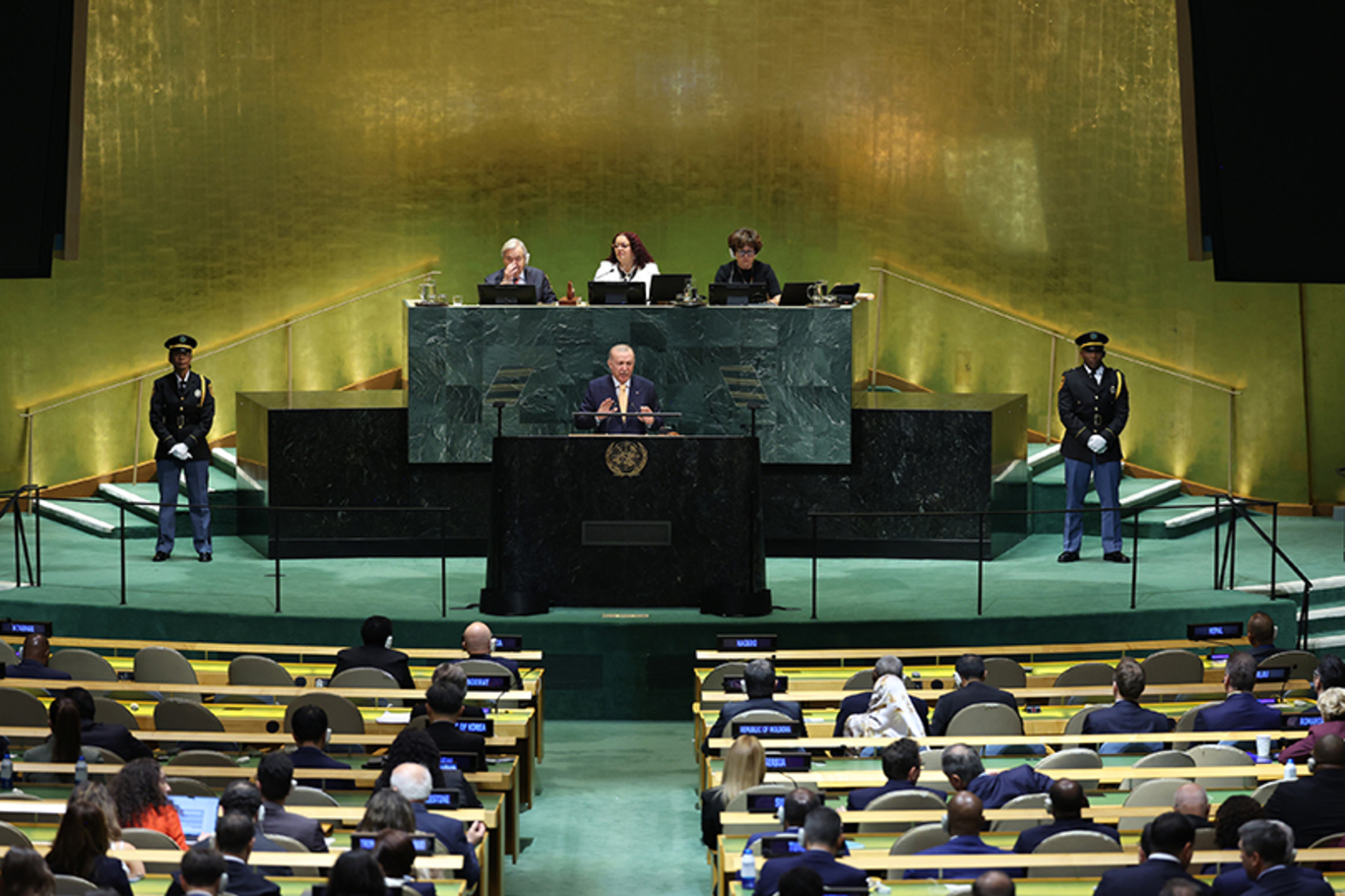
The Palestinian issue was a central theme of Erdoğan’s address to the UN General Assembly on Sept. 22.
Erdoğan called for greater international pressure to address the situation in Gaza and reiterated Türkiye’s support for a two-state solution. He also criticized the current structure of the UN Security Council, arguing that a system in which decisions affecting more than 190 countries are shaped by five permanent members does not adequately reflect the international community.
The UN separately reported that Erdoğan called for reform of the organization and renewed efforts to restore confidence in the multilateral system. He also highlighted the humanitarian situation in Gaza and the wider consequences of conflicts in the Middle East and elsewhere.
Reuters reported that Erdoğan urged countries that do not recognize a Palestinian state to reconsider their positions and called for international pressure over the Gaza crisis. Türkiye has repeatedly described Israel’s military campaign in Gaza as genocide, while Israel rejects that characterization.
During his meeting with Guterres, Erdoğan said developments in Gaza, the West Bank and Jerusalem remained major concerns for Türkiye and argued that the foundations for a two-state solution needed to be preserved.
The two leaders also discussed Ukraine, Iran and Cyprus, according to the UN.
New Türkiye-Iraq understanding
One of the most consequential developments during Erdoğan’s New York visit was a new understanding between Türkiye and Iraq on security cooperation and the future of the Turkish military facility at Bashiqa-Zilkan in northern Iraq.
Erdoğan met Iraqi Prime Minister Ali al-Zaidi on Sept. 23, with the two sides agreeing to deepen security cooperation, strengthen Iraqi state authority in Sinjar and address the presence of foreign armed groups.
Under the agreement, Turkish forces are to gradually hand over the Bashiqa-Zilkan base to the Iraqi federal government according to a mutually agreed mechanism and timetable, subject to progress in Iraq’s implementation of the agreed security measures.
The agreement also calls for increased bilateral trade and investment and faster implementation of joint strategic projects, particularly the Development Road project linking Iraq with Türkiye and wider international markets.
The announcement was described by international media as a significant development in Ankara-Baghdad security relations.
Regional diplomacy
Erdoğan also met with Libyan Presidential Council President Mohamed Younis al-Menfi, emphasizing the continuation of dialogue and reconciliation efforts in Libya.
According to Türkiye’s Directorate of Communications, Erdoğan said Ankara would not support any arrangement that was contrary to Libya’s interests and highlighted ongoing cooperation in energy, defence and mining. He also invited al-Menfi to attend the COP31 leaders’ summit in Antalya.
In talks with Kuwait’s Crown Prince Sheikh Sabah Khaled Al-Hamad Al-Sabah, Erdoğan discussed bilateral cooperation and regional developments, including energy and security.
He similarly met Lebanese Prime Minister Nawaf Salam and said Türkiye would continue supporting Lebanon with humanitarian and medical assistance while seeking long-term stability.
Talks with Georgian Prime Minister Irakli Kobakhidze focused on trade, transport and security, while Erdoğan told Kosovo Prime Minister Albin Kurti that Türkiye would continue supporting dialogue in the Balkans and efforts to strengthen bilateral economic and security ties.
Türkiye-US relations and Iran
Erdoğan also participated in a meeting hosted by Trump on Iran that brought together leaders and senior representatives from Gulf Cooperation Council countries as well as other regional states.
According to Türkiye’s Directorate of Communications, Trump said negotiations involving Iran had gained momentum and that Washington was monitoring developments toward a possible agreement.
The issue of Iran also featured in Erdoğan’s broader diplomatic discussions as regional tensions remained a major concern during the UN session.
Erdoğan has argued that diplomatic mechanisms should remain central to resolving regional disputes and has called for efforts to reduce tensions rather than allowing conflicts to widen.
Separately, at an event marking 100 years of diplomatic relations between Türkiye and the United States, Erdoğan said the two countries needed close dialogue because conflicts and crises in the Middle East, Africa and Asia had global consequences.
He also called for deeper economic and trade cooperation between Ankara and Washington.
Ukraine and Black Sea security
The Russia-Ukraine war was another major issue on Erdoğan’s diplomatic agenda.
In meetings with Guterres, Polish President Karol Nawrocki and Ukrainian President Volodymyr Zelenskyy, Erdoğan reiterated Türkiye’s willingness to support efforts aimed at ending the conflict through diplomacy.
During his meeting with Zelenskyy, Erdoğan said Ankara was prepared to continue efforts to revive direct negotiations between Russia and Ukraine.
The Turkish president also raised concerns about the safety of commercial shipping in the Black Sea and said attacks on merchant vessels were unacceptable.
Türkiye has sought to maintain communication with both Moscow and Kyiv throughout the war and has previously hosted negotiations between the two sides.
Armenia and Azerbaijan
Erdoğan also held talks with Armenian Prime Minister Nikol Pashinyan, focusing on the normalization of Türkiye-Armenia relations.
According to the Turkish presidency, Erdoğan welcomed reciprocal steps taken in the peace process between Armenia and Azerbaijan and said continued cooperation at international forums could contribute to normalization between Ankara and Yerevan.
Türkiye and Armenia have been pursuing a gradual normalization process after decades of strained relations, while Ankara has closely linked the broader regional normalization process to developments between Armenia and Azerbaijan.
Economic diplomacy
Economic relations featured prominently in Erdoğan’s programme, particularly during his meeting with the Türkiye-US Business Council.
The Turkish president said Ankara wanted to translate what he described as improved political coordination with Washington into stronger economic and commercial ties.
He highlighted Türkiye’s efforts to attract investment, increase industrial value-added production and expand infrastructure related to artificial intelligence and digital transformation.
Erdoğan also said economic relations with the United States should not be evaluated solely through bilateral trade figures and called for a broader economic cooperation model.
Meetings with Vietnam, Georgia, Japan, Poland, Bangladesh and Gulf countries similarly included discussions on trade, energy, investment and defence-industry cooperation.
Climate and COP31
Climate change was another component of Erdoğan’s New York programme.
At the UN Climate Summit, Erdoğan said Türkiye was preparing new targets for the period leading to 2035, particularly in areas including electrification and zero waste.
He argued that climate policies should take into account countries’ differing economic circumstances and access to financing and technology.
Türkiye is also preparing to host COP31 in Antalya, with the Turkish government seeking to use the summit to promote cooperation between developed and developing countries on climate finance, technology and the green transition.
Message to Turkish citizens in the US
At the conclusion of his visit, Erdoğan met Turkish citizens and members of Muslim and Turkish-American organizations in New York.
He spoke about integration and assimilation, saying Turkish citizens abroad should maintain their cultural identity while participating fully in the societies in which they live.
He also referred to the upcoming US midterm elections and encouraged Turkish citizens living in the United States to participate in the democratic process.
Duran: Türkiye will continue to prioritize diplomacy
Following Erdoğan’s meetings, Turkish Presidential Communications Director Burhanettin Duran said the president’s intensive programme had conveyed Türkiye’s positions on peace, dialogue and diplomacy to international counterparts.
Duran said the discussions had covered regional crises, global security, economic and trade cooperation and climate change, while Gaza, preservation of the two-state solution and diplomatic efforts concerning the Russia-Ukraine war remained prominent issues.
He said Türkiye would continue to promote diplomacy and work toward what Ankara describes as a fairer international order.
Erdoğan’s four-day New York visit therefore combined high-level diplomacy on immediate conflicts with efforts to expand Türkiye’s bilateral economic and strategic relationships.
The Türkiye-Iraq agreement on Bashiqa-Zilkan, in particular, added a concrete security dimension to the visit, while Erdoğan’s UN address reinforced Ankara’s longstanding calls for UN reform and greater international action over Gaza. (ILKHA)
LEGAL WARNING: All rights of the published news, photos and videos are reserved by İlke Haber Ajansı Basın Yayın San. Trade A.Ş. Under no circumstances can all or part of the news, photos and videos be used without a written contract or subscription.
Afghanistan has continued efforts to expand its education infrastructure with the construction of a new school building worth $300,000 in the northern province of Kunduz.
The Israeli regime has approved plans for the construction of 567 new settlement units in two settlements in the Hebron (Al-Khalil) governorate in the occupied West Bank.
Djibouti and Ethiopia have launched the "Horn of Africa Energy Corridor" project to strengthen energy supply security and reduce costs and logistical risks in the transportation of petroleum products between the two countries.