Historian Ağırakça: Palestinian resistance could bring historic change to the Middle East
 13 oC

Güneşli

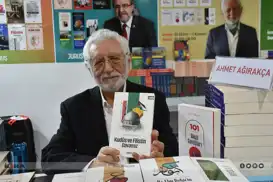
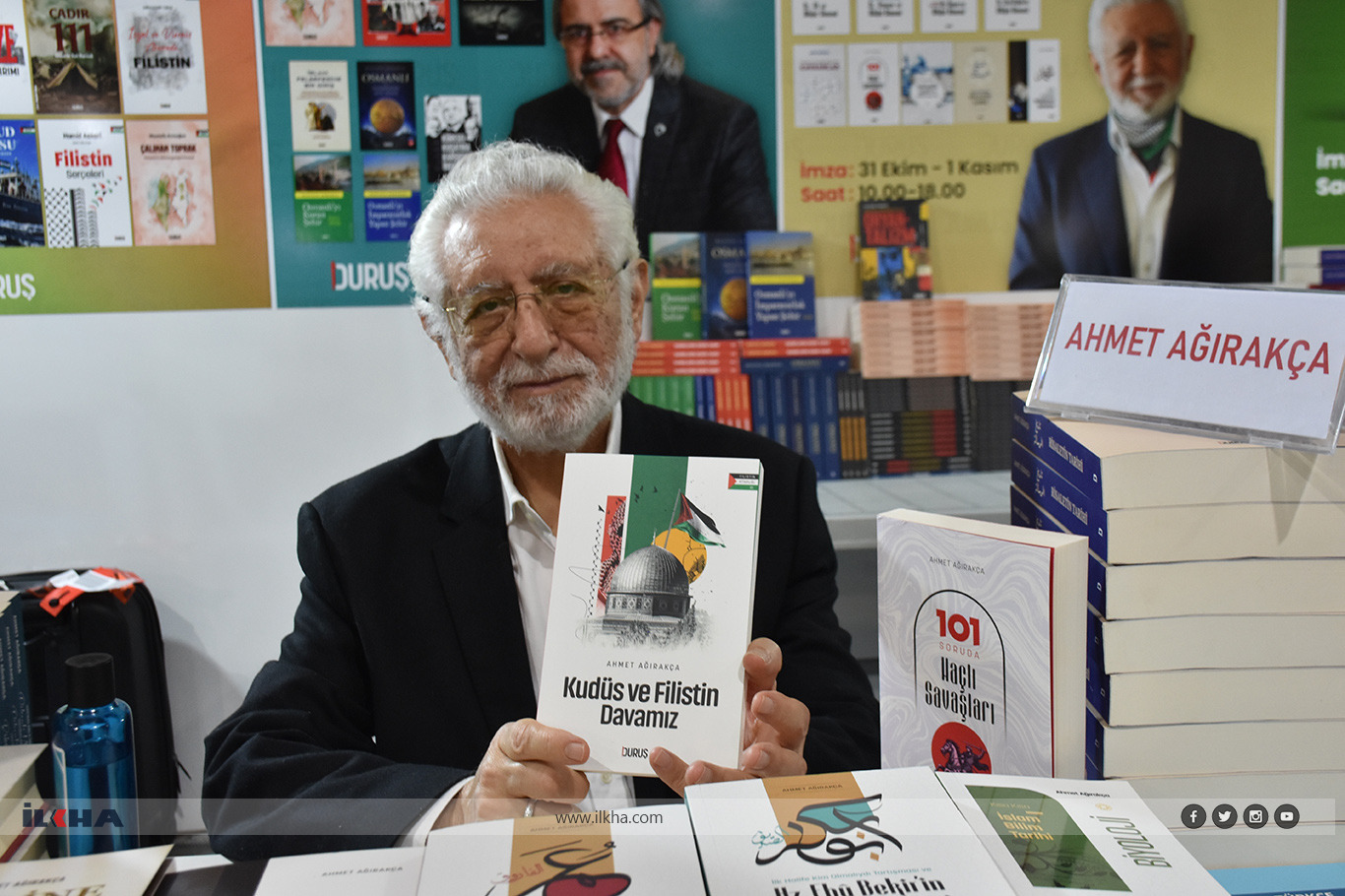
Historian and author Professor Ahmet Ağırakça has said that the Palestinian people's decades-long struggle for freedom is approaching a historic turning point, expressing hope that Jerusalem will be liberated and the political balance in the Middle East will change.
Speaking to İLKHA during the 12th Malatya Book Fair, where he participated in a book-signing event, Ağırakça discussed the Palestinian cause, the future of Jerusalem, the scientific legacy of Islamic civilization, artificial intelligence, higher education in Türkiye and rising Islamophobia in the West.
He argued that the fragmentation of the Muslim world was largely shaped by colonial interventions following World War I, when Britain and France drew borders across the region without regard for the aspirations of its people.
“Unfortunately, the Islamic world was fragmented after the First World War by the schemes of the British and the French. The borders were determined with rulers in their hands, and states and administrations emerged in which Muslims had no say whatsoever,” he said.
Ağırakça described Palestine as one of the most tragic consequences of that colonial legacy, saying that while plans had envisaged the establishment of a Palestinian state, British policies instead paved the way for the creation of a Zionist state in the region.
Despite decades of dispossession and occupation, he said, the Palestinian people had never abandoned their struggle.
“I believe that this struggle, which has been going on for approximately 80 years, is gradually approaching success. God willing, the maps will change. In my opinion, the first map that will change will be that of the existing Zionist state,” he said.
He expressed hope that a new regional political process could emerge through greater cooperation among Muslim countries, suggesting that the participation of Syria, Jordan and Egypt in what he referred to as the Mecca Alliance could produce a different balance of power in the region.
Predicting further instability in the Middle East, Ağırakça drew a historical comparison between the Crusader occupation of Jerusalem and the current Israeli occupation.
“The occupation of Jerusalem by the Crusaders during the First Crusade lasted 88 years. The current Zionist occupation is also approaching 80 years. Therefore, I believe that Jerusalem will regain its freedom before 88 years are completed,” he said.
Islamic civilization's scientific legacy must be rediscovered
Turning to the challenges facing younger generations in the digital age, Ağırakça warned against relying excessively on artificial intelligence as a source of knowledge, stressing that books and original scholarly works remain essential for understanding Islamic history and civilization.
He acknowledged that artificial intelligence can provide useful information but cautioned that it can also produce inaccurate answers.
“Accurate information is found in the sources. Our young people should turn to books to learn about the contributions of Muslim scholars to medicine, astronomy, physics, chemistry, mathematics and other sciences,” he said.
Ağırakça particularly encouraged students and researchers to learn Arabic so they could study the intellectual and scientific heritage of Islamic civilization directly from original texts.
He said Muslims had made significant contributions to scientific development over approximately a thousand years and that these achievements should be studied through primary sources rather than superficial accounts.
“Young people who want to research these subjects in greater depth should learn Arabic and read our civilizational and scientific history from its original sources. They should not place too much trust in artificial intelligence,” he said.
Neglect of scientific research weakened the Muslim world
Assessing the reasons behind the scientific decline of the Islamic world, Ağırakça said the neglect of scientific research after the 17th century had contributed significantly to the widening gap between Muslim societies and the West.
He noted that Muslim scholars had made major advances in numerous scientific disciplines up to the 16th century but argued that subsequent generations increasingly relied on repeating existing knowledge rather than pursuing new discoveries.
“If we had continued the great discoveries and scientific works produced up to the 16th century, we would have been far ahead of the West,” he said.
Ağırakça maintained that the revival of Islamic civilization was possible if Muslim societies rediscovered their scholarly heritage and invested in contemporary research.
He called for renewed efforts in mathematics, physics, chemistry, medicine, astronomy and geography, saying that building on the achievements of earlier Muslim scholars could help restore the intellectual dynamism of the Islamic world.
Türkiye needs stronger universities and more academics
Commenting on the academic environment in Türkiye, Ağırakça said the rapid expansion of the country's university system had not always been matched by sufficient numbers of qualified academic staff.
He said that although some universities had produced research of a high standard, shortages of faculty members had weakened academic performance in several institutions.
The problem was particularly visible in eastern provinces, where academics often preferred to work in larger cities, leaving universities in less-developed regions struggling to attract sufficient staff.
“Although a very large number of universities have been opened in Türkiye, because there are not enough faculty members, the desired academic studies could not be carried out everywhere,” he said.
Nevertheless, Ağırakça expressed optimism about younger academics, noting that many were conducting promising research and that Türkiye could improve its academic standing through sustained investment and hard work.
Gaza's resilience challenges Islamophobia in the West
Addressing rising Islamophobia in Western countries, Ağırakça said Muslims should respond by representing Islam accurately, demonstrating its moral values through their conduct and explaining its teachings through sound methods.
He argued that the resilience and religious commitment displayed by Palestinians in Gaza during Israel's devastating war had also influenced perceptions of Islam in Europe.
“If we live Islam, introduce it correctly and explain it properly, we can be successful in partially preventing Islamophobia,” he said.
Ağırakça pointed to an example of a Dutch political figure who, according to his account, had previously expressed hostility toward Islam but later began studying the Quran and the Prophet Muhammad's life before embracing the religion.
He also claimed that interest in Islam had increased in parts of Europe following the Gaza war, attributing this partly to the patience, faith, resilience and moral strength demonstrated by Palestinians enduring the Israeli assault.
“The patience, reliance on God, resistance, understanding, moral structure and attachment to Islam of the people of Gaza can create a great impact in Europe,” he said.
Ağırakça stressed that Muslims should respond to hostility not only through words but also by embodying the values of Islam in their daily lives.
'The real place to learn knowledge is books'
Concluding his remarks, Ağırakça urged young people to develop a strong reading habit and avoid allowing the internet, smartphones and television to replace serious intellectual engagement.
“My advice to all our young people is: please read books. Do not pay too much attention to the internet, small electronic devices, phones and televisions. The real place where you should learn knowledge is books,” he said. (ILKHA)
LEGAL WARNING: All rights of the published news, photos and videos are reserved by İlke Haber Ajansı Basın Yayın San. Trade A.Ş. Under no circumstances can all or part of the news, photos and videos be used without a written contract or subscription.
Recent protests in France that began over education-related problems and later escalated into violent clashes and looting reflect deeper social, economic and political tensions in the country, according to Abdulmuttalip Güngen, Chairman of the Strategic Thinking and Analysis Center (SDAM).
The deputy secretary-general of the Islamic Jihad Movement, Mohammed al-Hindi, said the Al-Aqsa Flood operation fundamentally altered the strategic landscape of the region, arguing that the role assigned to the Israel regime has effectively come to an end and that its international standing has suffered irreversible damage.
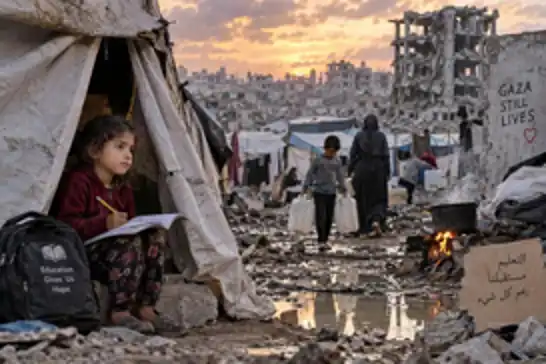
Professor Dr. Vechi Sönmez, a faculty member at Batman University's Faculty of Islamic Sciences, has called on Muslim countries to unite and establish a deterrent force against Israel's ongoing attacks on Palestinians, stressing that the resistance in Gaza continues despite years of bloodshed, destruction and immense suffering.