New study suggests ancient Mars was warm, wet and potentially habitable

 13 oC
13 oC 
Güneşli

A new scientific study suggests that Mars may have experienced a warm and wet climate billions of years ago, challenging the long-standing theory that the planet was predominantly cold and icy during its early history.
The findings focus on the Noachian epoch, a period between approximately 4.1 and 3.7 billion years ago, when Mars — like Earth, which is about 4.5 billion years old — was undergoing intense geological transformation. This era coincided with the Late Heavy Bombardment, a turbulent phase in solar system history marked by catastrophic meteorite impacts across planetary bodies.
Scars of a Violent Era
Two of the most dramatic remnants of this period on Mars are the massive Hellas and Argyre impact basins. Each stretches more than a thousand miles across and is vast enough to contain more water than the Mediterranean Sea. Despite the destructive nature of the bombardment, scientists believe this epoch may have been the most habitable in Mars’ history.
Evidence of ancient water activity from this time is widespread. Researchers have identified dried river valleys, lake beds, deltas and even ancient coastlines — all pointing to sustained interaction with liquid water.
Climate Debate: Icy World or Greenhouse Planet?
For decades, scientists have debated whether early Mars was largely frozen, with only brief warming episodes caused by volcanic eruptions or meteorite impacts, or whether it sustained a warmer, wetter, and mostly ice-free climate.
During the Noachian, the Sun was about 30% dimmer than it is today. To maintain liquid water under such reduced solar energy, Mars would have required a thick atmosphere rich in greenhouse gases such as carbon dioxide. However, at high pressures, CO2 tends to condense into clouds, potentially weakening the greenhouse effect — a factor that has long supported the colder-climate hypothesis.
New Evidence From Perseverance
The latest research draws on data from NASA’s Mars 2020 Perseverance Rover, which landed in Jezero crater in February 2021. The crater was selected because orbital observations indicated it once hosted a lake fed by flowing rivers.
Inside one of the ancient water-carved channels, scientists analyzed aluminum-rich clay pebbles known as kaolinite. These minerals show signs of intense chemical weathering by water. Crucially, they are depleted in iron and magnesium but enriched in aluminum and titanium — a composition that suggests they were altered not by short-lived hydrothermal events, but by persistent rainfall and moderate temperatures.
The chemical signature of these Martian clays closely resembles similar clay deposits found on Earth from periods characterized by warm, greenhouse climates. Researchers concluded that these pebbles likely formed during some of the wettest and potentially most habitable intervals in Mars’ history.
According to the study, such conditions may have lasted from thousands to millions of years — a timeframe considered significant for the potential emergence of life.
Implications for the Search for Life
The findings strengthen the possibility that Mars once supported life. Recently, Perseverance also detected potential biosignatures in samples collected from Jezero crater. These samples have been sealed and stored on the rover for a planned return-to-Earth mission.
However, NASA recently canceled the original Mars sample return mission, delaying the opportunity for detailed laboratory analysis on Earth. Whether these samples can ultimately confirm evidence of life depends on meeting the “Knoll criterion,” a standard proposed by astrobiologist Andrew Knoll. The criterion states that a finding must not only be explainable by biology, but must be impossible to explain without it.
A Lost Tropical World?
If confirmed, the study paints a striking picture of ancient Mars — a world that may once have featured rainfall, flowing rivers, lakes, and possibly even a primitive ecosystem, billions of years before humans appeared on Earth.
Today, Jezero crater is a barren and wind-swept landscape. But the new research suggests that, long ago, it may have been one of the most Earth-like environments in the solar system — and perhaps a cradle for life beyond our planet. (ILKHA)
LEGAL WARNING: All rights of the published news, photos and videos are reserved by İlke Haber Ajansı Basın Yayın San. Trade A.Ş. Under no circumstances can all or part of the news, photos and videos be used without a written contract or subscription.

Groups of Israeli settlers entered the courtyards of the Al-Aqsa Mosque compound on Wednesday morning under police protection, as access for Palestinian worshippers was heavily restricted, according to the Islamic Awqaf authorities in Jerusalem.

Germany’s fertility rate fell to its lowest level in nearly three decades in 2025, underscoring the country’s growing demographic challenges as births dropped to a post-war record low, according to figures released by the Federal Statistical Office of Germany on Tuesday.

Thousands of protesters took to the streets across South Africa on Tuesday, demanding the removal of undocumented migrants and prompting a major security operation as authorities sought to prevent a repeat of past outbreaks of xenophobic violence.
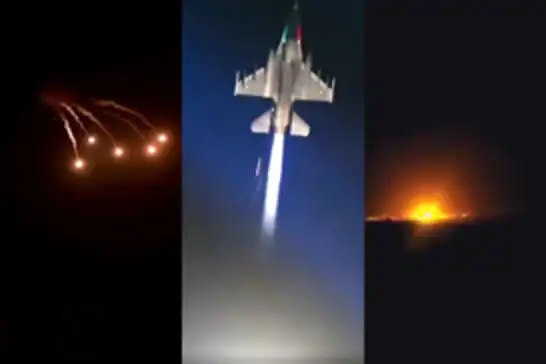
The Islamic Emirate of Afghanistan said it carried out strikes along the Pakistan border, injuring several people in Pakistan’s southwestern Balochistan province, prompting Pakistan to shoot down four rudimentary drones and issue a stern warning of a strong response.