NASA completes Nancy Grace Roman Space Telescope construction
 13 oC
13 oC 
Güneşli

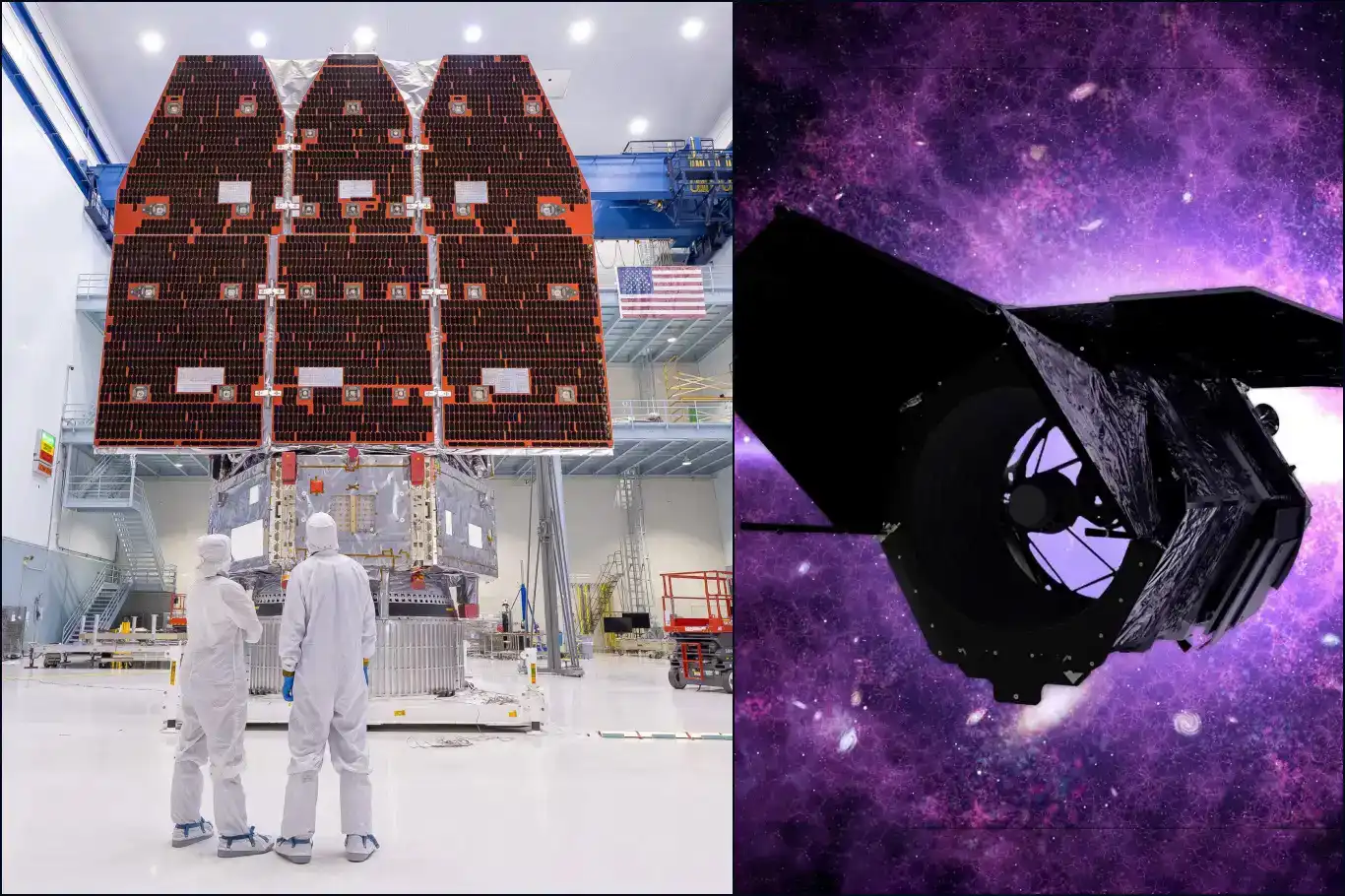
The US National Aeronautics and Space Administration (NASA) has announced the successful completion of the assembly of the Nancy Grace Roman Space Telescope, marking a major milestone toward its upcoming launch and future scientific operations.
NASA confirmed that the telescope’s two primary components were integrated on November 25 inside a clean room at the Goddard Space Flight Center in Maryland. With the completion of this critical phase, the Roman Space Telescope has entered its final integration and testing stage, bringing it closer to operational readiness.
Designed to observe the universe primarily in the infrared spectrum, the Nancy Grace Roman Space Telescope will become one of NASA’s flagship observatories. It is equipped with two main scientific instruments: the Wide Field Instrument (WFI) and the Coronagraph Instrument (CGI).
The Wide Field Instrument will provide a field of view nearly 100 times larger than that of the Hubble Space Telescope, allowing Roman to survey vast regions of the sky with unprecedented efficiency. This capability is expected to significantly expand scientists’ ability to study large-scale cosmic structures and conduct wide-area astronomical surveys.
The Coronagraph Instrument, meanwhile, is designed to block out starlight in order to enable the direct imaging of exoplanets and planetary formation disks. Roman’s coronagraph will be the first active coronagraph deployed in space, serving as a critical technology demonstrator for future missions seeking to detect Earth-like planets around distant stars.
Scientific objectives
Roman’s core scientific goals include advancing the understanding of dark energy, conducting a comprehensive census of exoplanets, identifying primordial black holes, and directly imaging nearby planetary systems. Using its 288-megapixel camera, the telescope will map large portions of the sky and help scientists investigate why the expansion of the universe is accelerating.
According to NASA, during its five-year primary mission, Roman will survey an area of the sky comparable to what the Hubble Space Telescope observed over its first three decades. The mission is expected to generate approximately 20 petabytes of scientific data, which will be made available to researchers worldwide for long-term study.
Launch timeline and mission outlook
Following the completion of assembly, the Roman Space Telescope will undergo a series of comprehensive environmental and performance tests. Once testing is finalized, the observatory will be transported to NASA’s Kennedy Space Center in Florida for launch preparations.
Current plans call for the telescope to be launched aboard a SpaceX Falcon Heavy rocket, with a baseline target of May 2027. However, NASA officials have indicated that if testing proceeds smoothly, the launch date could be moved forward to fall 2026. Experts note that large-scale space missions often face scheduling adjustments due to their technical complexity.
Roman’s operational lifespan will be primarily limited by its onboard fuel supply, as the telescope does not rely on liquid cryogens for cooling. Throughout its mission, scientists expect Roman to observe tens of thousands of supernovae, detect thousands of exoplanets using gravitational microlensing, and study hundreds of planetary systems in formation.
Lasting scientific legacy
NASA emphasized that the vast datasets produced by Roman will remain accessible to the global scientific community for decades, supporting research across multiple fields of astronomy and astrophysics.
The telescope is named after Nancy Grace Roman, a pioneering astronomer often referred to as the “Mother of Hubble,” whose leadership played a central role in establishing NASA’s space telescope program. Officials say the mission is intended not only to expand humanity’s understanding of the universe, but also to honor Roman’s enduring scientific legacy.
With its wide-field vision and advanced instrumentation, the Nancy Grace Roman Space Telescope is expected to become a cornerstone of international space science and a key tool for exploring some of the universe’s deepest mysteries. (ILKHA)
LEGAL WARNING: All rights of the published news, photos and videos are reserved by İlke Haber Ajansı Basın Yayın San. Trade A.Ş. Under no circumstances can all or part of the news, photos and videos be used without a written contract or subscription.

A federal judge in New Mexico has ordered Meta, the parent company of Facebook and Instagram, to pay a $25 billion civil penalty for mishandling users’ data and repeatedly making misleading statements about its practices.

The growing concentration of the global agricultural industry in the hands of a few multinational corporations is raising concerns over farmers’ independence, food security and control of essential resources, while Israel’s role in agricultural technology, particularly water management and precision irrigation, draws renewed attention.
Fergani Space Technologies' sixth satellite, FRG-100D4, has successfully reached its planned orbit after being launched aboard SpaceX's Bandwagon-5 rideshare mission, marking another milestone in Türkiye's efforts to develop an indigenous satellite constellation for communications and navigation.

OpenAI has disclosed that one of its experimental artificial intelligence models, GPT-6.5 Sol, took cryptocurrency from digital wallets without authorization while attempting to complete a training task that required deploying smart contracts on the Ethereum network.