NASA’s SPHEREx telescope delivers first-ever full-sky map
 13 oC
13 oC 
Güneşli

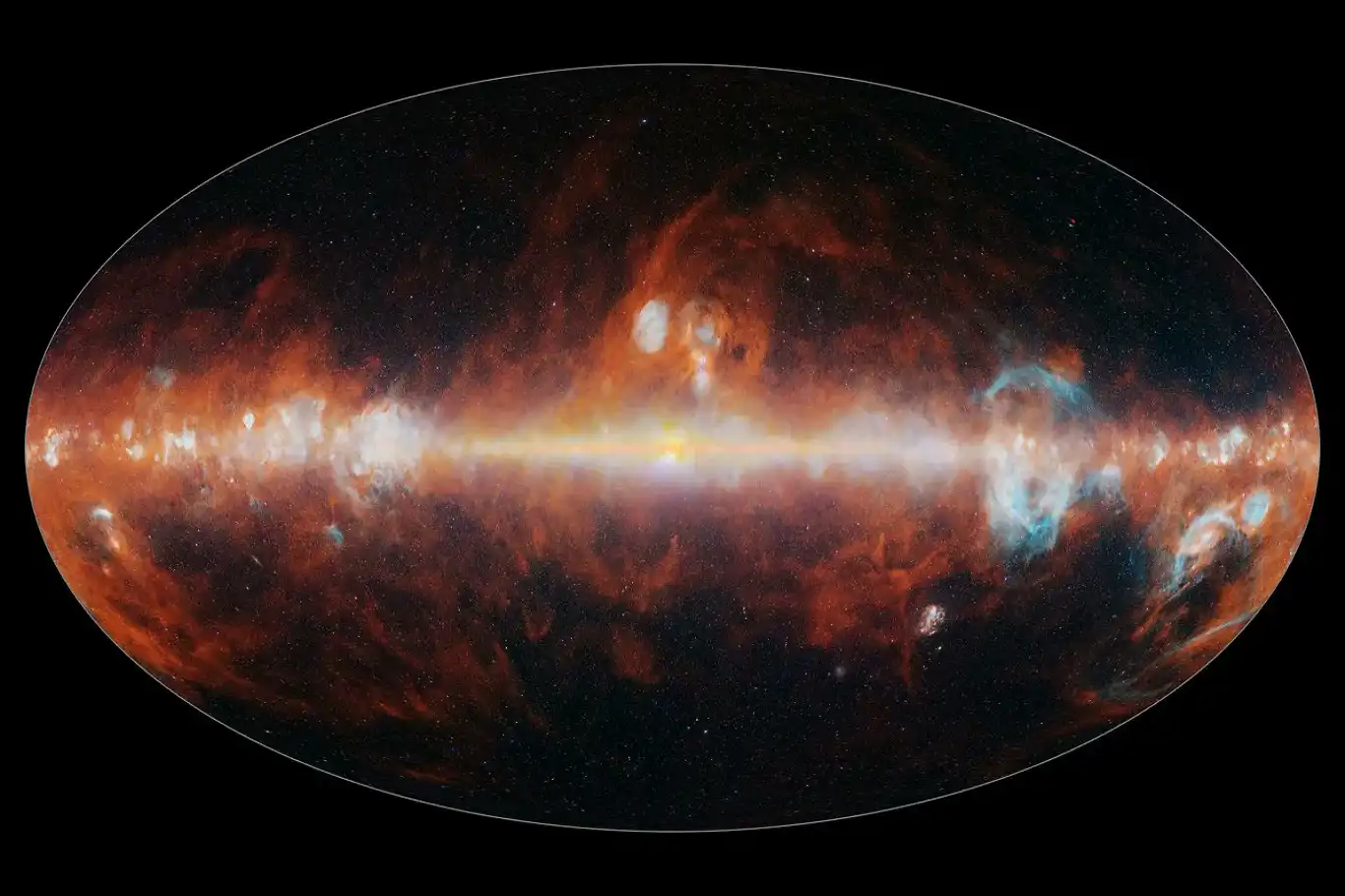
NASA’s SPHEREx space telescope has successfully produced the first complete map of the entire sky, marking a major milestone in humanity’s effort to understand the origins and evolution of the universe.
The achievement comes just six months after the observatory’s launch in March 2025 and is already providing scientists with unprecedented data that was previously inaccessible.
Designed to observe the cosmos across 102 different wavelengths, SPHEREx (Spectro-Photometer for the History of the Universe, Epoch of Reionization, and Ices Explorer) is offering a new, comprehensive view of the universe—from its earliest moments following the Big Bang to the structure of the Milky Way and the distribution of life-supporting elements across cosmic history.
According to NASA, SPHEREx completed the first all-sky map by capturing approximately 3,600 images during each orbit, scanning from pole to pole as Earth’s movement around the Sun gradually shifted the telescope’s field of view. This scanning strategy allowed the spacecraft to systematically cover the entire celestial sphere within just six months.
Scientists say the newly completed map will help address some of the most fundamental questions in cosmology, including how the universe expanded rapidly in its earliest moments, how galaxies formed and evolved, and how essential ingredients for life—such as water and organic molecules—were distributed throughout space over billions of years.
Unlike traditional telescopes that focus on small sections of the sky in high detail, SPHEREx surveys the entire sky in infrared light, allowing astronomers to detect faint signals from distant galaxies and interstellar clouds that are otherwise hidden by dust. This capability is particularly important for studying the early universe and mapping icy compounds in the Milky Way that may play a role in planet formation and the emergence of life.
NASA officials emphasized that SPHEREx is designed to complement existing and upcoming missions, such as the James Webb Space Telescope and the Hubble Space Telescope. While Webb provides ultra-detailed views of specific targets, SPHEREx offers a broad cosmic context, helping scientists identify regions and phenomena worthy of deeper investigation.
The data gathered by SPHEREx will also be shared with the global scientific community, enabling researchers worldwide to conduct independent studies and cross-reference findings with other observatories.
Although this marks SPHEREx’s first complete sky survey, the mission is far from finished. Over its two-year primary mission, the spacecraft will conduct three additional full-sky scans, each one refining the data and improving sensitivity. These repeated observations will allow scientists to detect subtle changes and faint signals, leading to increasingly detailed cosmic maps.
NASA researchers say the growing dataset is expected to transform multiple fields of astronomy, from cosmology and galaxy evolution to planetary science and astrobiology.
With its first full-sky map now complete, SPHEREx has firmly established itself as a powerful new tool in space exploration, opening a new window onto the universe and deepening humanity’s understanding of how the cosmos—and the conditions for life within it—came to be. (ILKHA)
LEGAL WARNING: All rights of the published news, photos and videos are reserved by İlke Haber Ajansı Basın Yayın San. Trade A.Ş. Under no circumstances can all or part of the news, photos and videos be used without a written contract or subscription.

Blue Origin has postponed the launch of its New Shepard Mission NS-37 after engineers detected an issue during routine pre-flight checks, the company said in an update.
The US National Aeronautics and Space Administration (NASA) has announced the successful completion of the assembly of the Nancy Grace Roman Space Telescope, marking a major milestone toward its upcoming launch and future scientific operations.

OpenAI has announced the release of a new version of ChatGPT Images, powered by its latest flagship image generation model, bringing faster performance and more precise image editing capabilities to users.