Scientists discover first-ever galactic system hosting three active supermassive black holes
 13 oC
13 oC 
Güneşli

U.S. astronomers have identified an extraordinarily rare cosmic system in which three merging galaxies each host an actively feeding, radio-bright supermassive black hole, offering unprecedented insight into how galaxies and black holes grow together over cosmic time.
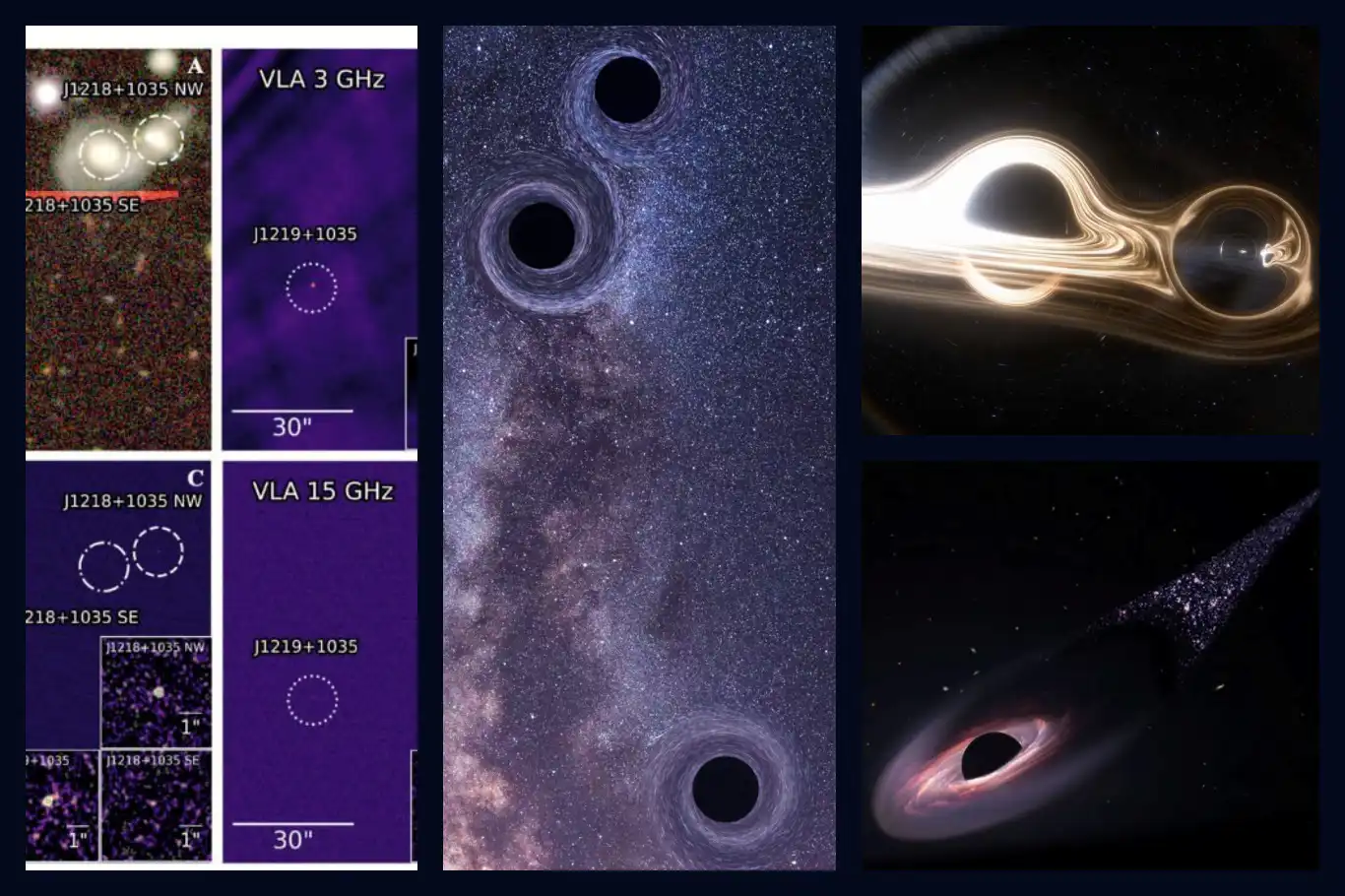
The system, known as J1218/1219+1035, lies about 1.2 billion light-years from Earth and consists of three interacting galaxies bound together by gravity. At the heart of each galaxy sits a supermassive black hole that is actively accreting material and emitting powerful radio signals—making the system the first confirmed triple radio active galactic nucleus (AGN) and only the third known triple AGN system discovered in the nearby universe.
“Triple active galaxies like this are incredibly rare, and catching one in the middle of a merger gives us a front-row seat to how massive galaxies and their black holes grow together,” said Dr. Emma Schwartzman of the U.S. Naval Research Laboratory, who led the research.
Using the National Science Foundation’s Very Large Array (VLA) and the Very Long Baseline Array (VLBA), the research team detected compact, synchrotron-emitting radio cores at the centers of all three galaxies. These radio cores are a hallmark of active supermassive black holes launching jets of high-energy particles at near-light speed.
The three galaxies are separated by distances of approximately 22,000 and 97,000 light-years, and show clear tidal distortions—evidence that they are in the midst of a gravitational merger. Astronomers say such systems are a key prediction of hierarchical galaxy formation, the process by which large galaxies like the Milky Way grow through repeated mergers with smaller galaxies.
“By capturing three actively feeding black holes in the same merging group, these observations provide a powerful laboratory for studying how galaxy interactions funnel gas into galactic centers and trigger black hole growth,” the researchers noted.
The unusual system was first identified using data from NASA’s Wide-field Infrared Survey Explorer (WISE), which hinted at the presence of obscured AGN hidden within dusty, interacting galaxies. Earlier optical observations confirmed an AGN in one galaxy and suggested mixed signals in another, but the nature of the third galaxy remained uncertain.
Only with high-resolution radio imaging at frequencies of 3, 10, and 15 gigahertz did astronomers definitively confirm that all three galaxies host active black holes. The radio emissions were found to be precisely aligned with each galaxy’s optical nucleus, ruling out alternative explanations such as star formation alone.
Analysis of the radio spectra revealed non-thermal synchrotron emission, characteristic of AGN activity. Two of the black holes showed steep radio spectra typical of compact jets, while the third exhibited an even steeper spectrum, possibly indicating unresolved jet or outflow activity.
The discovery pushes theoretical predictions into observational reality and suggests that triple AGN systems may be more common than previously thought, but difficult to detect without advanced radio instruments. Astronomers say future observatories, including the Square Kilometre Array (SKA), could uncover many more such systems.
“Triple radio AGN were long predicted by simulations, but rarely observed,” Dr. Schwartzman said. “This discovery opens a new window into the life cycle of supermassive black holes and the dramatic role galaxy mergers play in shaping the universe.”
The findings mark a major step forward in understanding how the most massive structures in the cosmos assemble and evolve. (ILKHA)
LEGAL WARNING: All rights of the published news, photos and videos are reserved by İlke Haber Ajansı Basın Yayın San. Trade A.Ş. Under no circumstances can all or part of the news, photos and videos be used without a written contract or subscription.

A UK-based firm has moved the concept of orbital manufacturing from science fiction toward tangible industry, successfully testing a miniature factory in space.

A UK-based firm has moved the concept of orbital manufacturing from science fiction toward tangible industry, successfully testing a miniature factory in space.

OpenAI has announced the opening of a new senior position focused on managing the risks posed by advanced artificial intelligence systems, offering an annual salary of up to $555,000, underscoring the growing importance of AI safety and governance.