Abu Obeida urges Palestinians to defend Al-Aqsa againsts Israeli violations

 13 oC
13 oC 
Güneşli

Abu Obeida, spokesperson for the Al-Qassam Brigades, the armed wing of the Hamas movement, has called on Palestinians in the occupied West Bank and Jerusalem to stand against the escalating Israeli attacks on Al-Aqsa Mosque, Palestinian land and their rights.
In a statement marking the anniversary of the 1969 arson attack on Al-Aqsa Mosque, Abu Obeida urged Palestinians to defend the sacred site, confront Israeli settlers and resist the occupation, while calling for those killed by Israeli forces to be remembered and honored.
His remarks came amid growing Palestinian concerns over Israeli policies and actions around Al-Aqsa Mosque and throughout the occupied West Bank, where settlement expansion, raids, arrests and settler attacks have intensified.
Abu Obeida also mourned Fathi Khazem, widely known as “Abu Raad,” who was killed by Israeli forces earlier in the day.
He described Khazem as the “father of martyrs” and a “hero of Jenin,” paying tribute to him as a prominent Palestinian figure who had endured the loss of his sons before being killed himself.
Abu Obeida said Khazem had now joined other Palestinians killed by Israel, including Abu Shanab, Al-Attar, Abu Shamala and Barhoum, portraying his death as part of a long line of Palestinian figures killed during the conflict.
Khazem was the father of Palestinian resistance fighters Raad and Abdul Rahman Khazem, who were killed by Israeli forces in Jenin in previous years. His death has consequently carried particular significance among Palestinians, with supporters portraying him as a symbol of steadfastness in the face of Israeli military operations.
Abu Obeida's statement was issued on the anniversary of one of the most traumatic attacks in the modern history of Al-Aqsa Mosque.
On August 21, 1969, Australian national Michael Dennis Rohan entered the Al-Aqsa compound and set fire to the Qibli Mosque. The blaze severely damaged the southern prayer hall and destroyed large portions of its historic interior.
Among the most significant losses was the Minbar of Salah al-Din (Saladin), the centuries-old pulpit that had been installed in the mosque after the liberation of Jerusalem from Crusader rule.
The attack triggered outrage across the Muslim world and contributed to the creation of the Organization of Islamic Cooperation (OIC), then known as the Organization of the Islamic Conference, in 1969.
For Palestinians, the anniversary has become a reminder of the vulnerability of one of Islam's holiest sites and the continuing dispute over Jerusalem.
The anniversary comes amid persistent Palestinian allegations that Israel is seeking to alter the historical and religious status quo at Al-Aqsa Mosque.
Palestinians have repeatedly condemned increased Israeli police presence at the compound, restrictions on Muslim worshippers and visits by Israeli settlers and far-right politicians.
They warn that attempts to impose new realities at the site could threaten its longstanding status as an exclusively Muslim place of worship.
Israeli authorities, meanwhile, maintain that security measures are necessary to prevent violence and protect visitors.
The dispute over Al-Aqsa has repeatedly become a flashpoint in the broader Israeli-Palestinian conflict, with developments at the holy site often triggering wider unrest across Jerusalem, the West Bank and Gaza.
Abu Obeida's appeal also comes as Palestinians in the occupied West Bank face an increasingly dangerous security environment.
Israeli military raids, arrests, demolitions and settler attacks have become a persistent feature of daily life in Palestinian communities, particularly in areas such as Jenin and Nablus.
Palestinian officials and rights groups have accused Israel of using military force and settlement expansion to consolidate its control over occupied territory and pressure Palestinians to leave their homes and lands.
Against this backdrop, Abu Obeida framed the defense of Al-Aqsa as inseparable from the wider Palestinian struggle over land, Jerusalem and national rights.
The 1969 fire remains deeply embedded in Palestinian and Muslim collective memory.
The destruction of parts of the Qibli Mosque and the loss of the Minbar of Saladin were seen as an assault not only on a historic monument but also on a site of profound religious significance.
More than five decades later, Palestinians continue to view Al-Aqsa as a central symbol of their identity and their claims to Jerusalem.
Abu Obeida's latest statement therefore links the memory of the 1969 fire with the current reality in the occupied Palestinian territories, arguing that the protection of Al-Aqsa cannot be separated from the protection of Palestinian land, dignity and lives.
As tensions continue to rise in Jerusalem and the West Bank, the anniversary has once again placed Al-Aqsa Mosque at the heart of the Palestinian-Israeli conflict, while Palestinian leaders and factions continue to call for international action to protect the holy site and Palestinian civilians. (ILKHA)
LEGAL WARNING: All rights of the published news, photos and videos are reserved by İlke Haber Ajansı Basın Yayın San. Trade A.Ş. Under no circumstances can all or part of the news, photos and videos be used without a written contract or subscription.

US President Donald Trump has escalated tensions with Iran by declaring that he now views the strategically vital Strait of Hormuz as “American territory.”
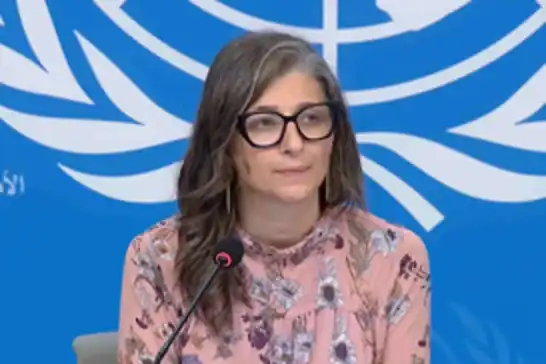
United Nations Special Rapporteur Francesca Albanese has sharply condemned Israel’s ongoing military actions in Gaza and the occupied West Bank, describing the Israeli army as the “MOST IMMORAL ARMY” and accusing it of continuing to inflict death, destruction and deprivation on Palestinians.

Germany's failure to refill its natural gas storage facilities at the expected pace is raising concerns over energy security ahead of the winter season. Storage levels remain at around 50 percent, making it increasingly difficult to meet legally required targets, while opposition parties and industry representatives have criticized the government's energy policy.