Japan earthquake kills 13 as search continues for people trapped in mall
 13 oC
13 oC 
Güneşli

Rescue teams raced against time on Wednesday to search for survivors after a powerful 7.1-magnitude earthquake struck southern Japan, killing at least 13 people, injuring dozens and causing widespread destruction across Kumamoto Prefecture.
The quake, which struck late Tuesday, left thousands of homes without electricity, damaged roads and bridges, disrupted transportation, and forced the evacuation of hundreds of thousands of residents as authorities warned of possible aftershocks and landslides.
One of the deadliest incidents occurred at an Aeon shopping mall near Kumamoto City, where a partial building collapse followed an apparent explosion about an hour after the earthquake.
Rescuers pulled eight people from the rubble, but three later died from their injuries. Mall operator Aeon said four employees remained unaccounted for after accounting for approximately 2,700 staff members. Customers had been safely evacuated immediately after the initial quake.
Emergency crews reported smelling gas inside the damaged building, prompting authorities to investigate whether a gas leak triggered the explosion.
"Even now, there are people waiting to be rescued, and this is a race against time," Prime Minister Sanae Takaichi told reporters.
"We will marshal all available resources on the ground to save and rescue as many people as possible."
Firefighters, police officers, and around 170 military personnel concentrated search efforts around areas where cries for help had been detected inside the mall. More than 4,500 members of Japan's Self-Defense Forces have been deployed throughout the disaster zone to assist with rescue and recovery operations.
Elsewhere, seven workers remained missing after a chimney collapsed at a Nippon Paper Industries factory, while four others suffered serious injuries. Hospitals across the region reported treating dozens of earthquake victims.
Authorities ordered approximately 260,000 residents across Kumamoto Prefecture to evacuate to emergency shelters. Police said they received 386 emergency calls following the quake, many involving collapsed buildings and trapped residents.
The earthquake's epicenter was located about 20 kilometers south of Kumamoto City, the largest urban center on the island of Kyushu, home to roughly 700,000 people.
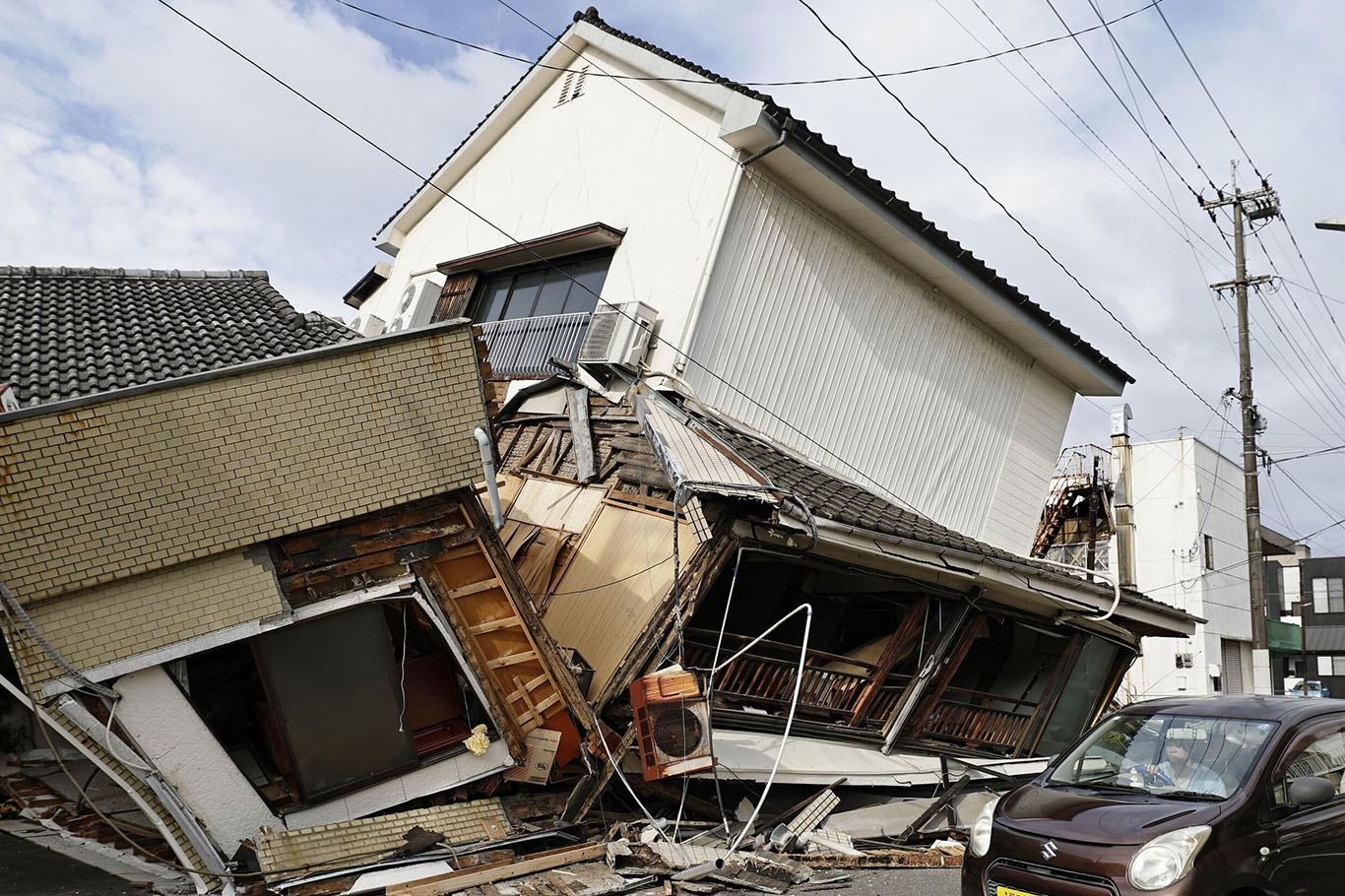
In Yatsushiro City, one of the hardest-hit areas, numerous homes suffered roof damage while several buildings collapsed completely. Roads were cracked and buckled, and part of a bridge collapsed into the Kumagawa River.
Officials warned residents to remain alert for strong aftershocks over the coming week and cautioned that heavy rain or unstable ground could trigger landslides.
The earthquake also left more than 36,000 households without electricity as temperatures climbed to around 34 degrees Celsius, raising concerns over heat-related illnesses among displaced residents.
Healthcare services were severely strained by the disaster.
One hospital in Uki City near the epicenter said a prolonged power outage had rendered much of its equipment unusable.
"It has become like a field hospital," a hospital administrator told public broadcaster NHK.
Another nearby hospital suspended new admissions after treating 86 injured patients, including three in critical condition.
Transportation networks also suffered significant disruptions. Several passengers aboard high-speed trains sustained injuries, while rail operators suspended bullet train services immediately after the earthquake.
The collapse of the Aeon shopping mall drew nationwide attention. Images from the scene showed one side of the complex, which houses around 200 stores, ripped open, exposing steel beams and scattering debris across the parking area.
The disaster also disrupted industrial production in one of Japan's major manufacturing hubs.
Major companies, including Renesas Electronics, Sony, Tokyo Electron and Honda, temporarily suspended operations at facilities in the affected region. Toyota Motor announced it would halt production at three factories outside Kumamoto through Friday due to disruptions affecting suppliers.
Taiwan Semiconductor Manufacturing Company (TSMC) evacuated workers from its Kumamoto facility as a precaution before gradually resuming operations later Tuesday.
Japan sits along the seismically active Pacific "Ring of Fire" and experiences about 20 percent of the world's earthquakes measuring magnitude 6.0 or greater.
The latest disaster revived memories of the devastating Kumamoto earthquakes a decade ago, which claimed 275 lives, injured more than 2,700 people and caused extensive damage to thousands of buildings, including Kumamoto Castle.
Tuesday's earthquake also damaged several historic structures, including centuries-old shrines with tiled roofs and a 17th-century tea house, adding to the cultural losses from one of Japan's strongest earthquakes in recent years. (ILKHA)
LEGAL WARNING: All rights of the published news, photos and videos are reserved by İlke Haber Ajansı Basın Yayın San. Trade A.Ş. Under no circumstances can all or part of the news, photos and videos be used without a written contract or subscription.
Iran's Islamic Revolutionary Guard Corps (IRGC) announced early Wednesday that it had launched a ballistic missile attack on a US military command center and air base in Jordan, describing the strike as retaliation for American aggression against the Islamic Republic.

Afghanistan's Islamic Emirate is strengthening its relations with neighboring and regional countries through a policy focused on economic cooperation and regional connectivity, government spokesman Zabihullah Mujahid said during a virtual media briefing from Kandahar.
Multiple locations across Iraq were hit by airstrikes early Wednesday as the United States and Saudi Arabia announced they had carried out a coordinated military operation against Iran-aligned armed groups operating inside the country.