HÜDA PAR MP urges government to tackle rising living costs and economic grievances
 13 oC

Güneşli

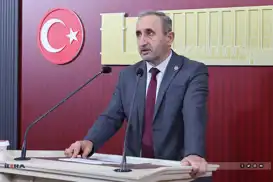
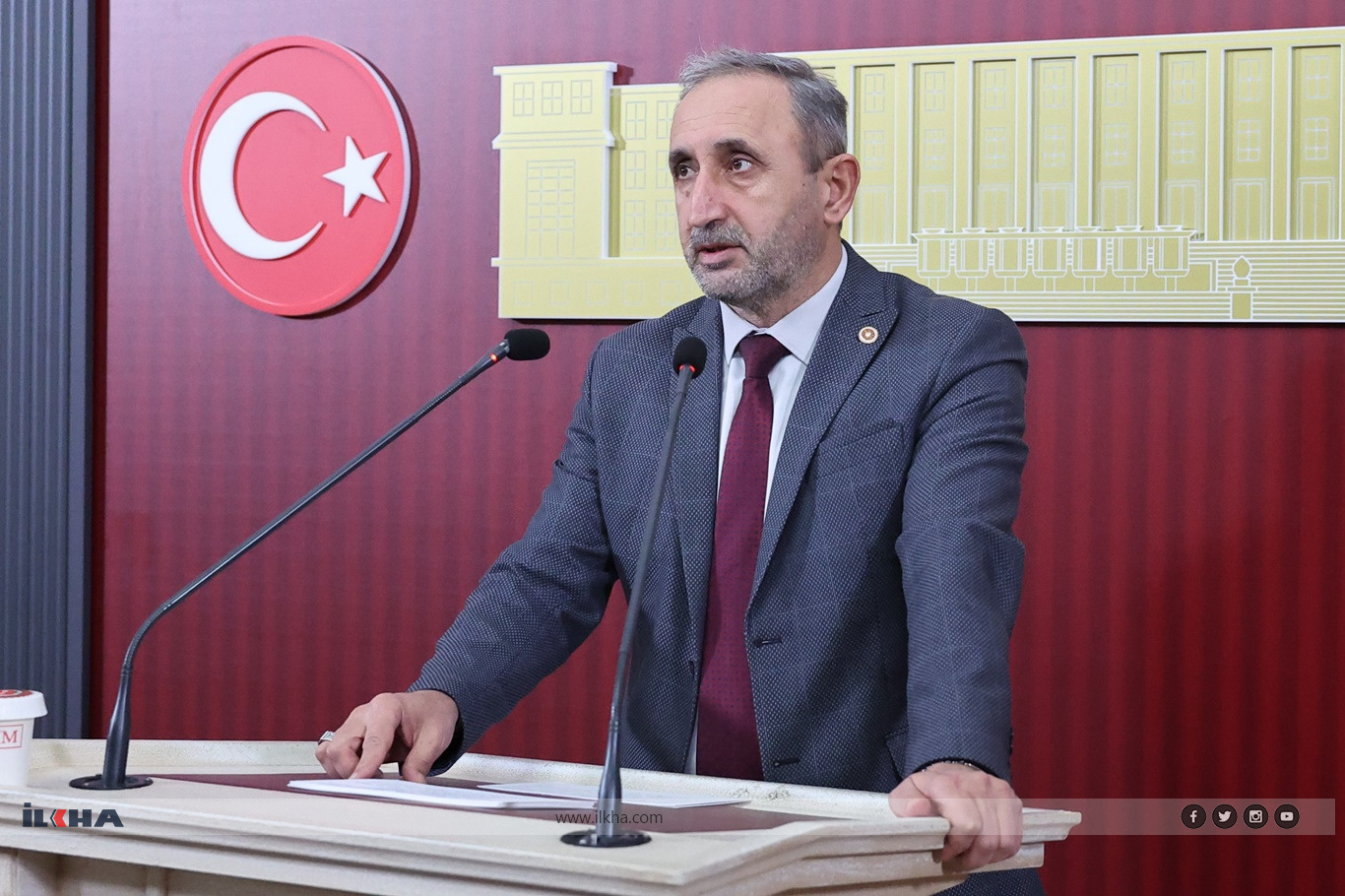
HÜDA PAR MP Şahzade Demir, drawing attention to the public’s livelihood difficulties through TurkStat’s announced November inflation data, stated that the high cost of living continues and emphasized that everyone named in the fund investigations must be held accountable.
HÜDA PAR Deputy Chairman and Member of Parliament Şahzade Demir, in a press conference he held at the Grand National Assembly of Türkiye (TBMM), made evaluations regarding the October inflation data announced by TurkStat, economic developments, food safety, revaluation rates, the victims of İhlas Finans, and MESEM supports.
Drawing attention to the public’s livelihood difficulties through the October inflation data announced by TurkStat, Demir said: “According to the TurkStat data announced on 3 November, inflation in October was realized as 2.58 percent monthly and 29.77 percent annually. The 3.50 percent monthly increase in food prices revealed that the fire in the kitchen has still not been extinguished. The high cost of living that the public feels in the marketplace, in rent, and in bills continues unabated.”
“The lowest pension should not remain below the minimum wage, and the minimum wage should not remain below the hunger threshold”
Stating that concrete steps must be taken regarding salary increases and base wages, Demir listed his solution proposals with the following statements:
“We see that the minimum-wage earner’s salary melts away before the month is even half over, while the pensioner cannot receive the return for the labor he has given for years. Getting by on one salary has now become almost impossible. For this reason, we raise it as a vital issue: The lowest pension must not remain below the minimum wage; pensioners must urgently be given a welfare share and a flat-rate increase; and the minimum wage must under no circumstances remain below the hunger threshold.”
“Everyone who reaches for the forbidden must be held accountable”
In his statement, Demir also touched on the fund investigations that have shaken the capital markets: “The allegations that have emerged with the fund investigation reveal serious problems regarding supervision and accountability in the capital markets. The fact that the same irregularities continue while the investigations are ongoing is a sign of a moral decay that needs to be reflected upon. Whoever it may be, everyone who reaches for the forbidden must be held accountable. The sweat of the people’s brow and their savings cannot be sacrificed to the interests of those who hold influence.”
“The priority must be people, justice, and fair sharing”
Emphasizing that the public’s real concern is making a living, Demir said: “While the people are struggling with the cost of living, it is unacceptable for Ankara to occupy itself with artificial agendas. The priority must be people, justice, and fair sharing.”
“Existing sanctions are insufficient to prevent violations”
Making statements regarding the processes of combating counterfeiting and adulteration in food, as well as the food safety and adulterated products issues that have recently resonated widely with the public, Demir said the following:
“The Ministry of Agriculture and Forestry’s practice of announcing to the public the companies that engage in counterfeiting and adulteration in food is an important application. However, the fact that the same companies are exposed again and again on different dates shows that the existing sanctions are insufficient to prevent violations. For this reason, gradual closure penalties should be applied according to the recurrence of the violation. Closure of the workplace for one month on the first violation, six months on the second violation, and prohibition of the enterprise from activity on the third violation should be brought onto the agenda. Legal regulations that will prevent those responsible from continuing the same activity under different names should also be made.”
“Visual deception must be ended”
Touching also on the misleading visuals on product packaging, Demir said: “Presenting products that contain a very low amount of fruit or vegetable in their content, or that use only aroma, with large fruit visuals on the packaging misleads the consumer. Clear and binding labeling standards must also be introduced on this matter.”
“Citizens must become part of the inspection via a mobile application”
Stating that technology must be integrated into inspection processes, Demir proposed a digital solution to the Ministry of Agriculture and Forestry:
“With a mobile application to be developed by the Ministry, by scanning the barcode the product’s content, additives, risky components, and the producer company’s past violations should be shown to the consumer. In this way, the consumer will not only be informed but will also become an active part of the inspection process.”
“The fight must not remain limited only to exposing companies”
Expressing that effective inspection, heavy sanctions, and consumer awareness must be addressed as a whole in order to protect public health, Demir invited the authorities to take concrete steps by saying: “Food safety is a matter that directly concerns public health and the healthy development of future generations. For this reason, the fight must not remain limited only to exposing companies; effective inspection, heavy and deterrent sanctions, and practices that raise consumer awareness must be put into effect as a whole.”
“Revaluation rates should not exceed the inflation target”
Evaluating also the 2027 revaluation rates that became clear with the announcement of the October inflation data, Demir used the following expressions: “With the announcement of the October inflation data, the revaluation rates covering taxes, fees, and administrative fines for 2027 have also been determined. Including October, the 12-month average increase rate realized compared to the same period of the previous year has been realized as 27.83 percent within the scope of revaluation.”
Drawing attention to the fact that the scope of revaluation is quite broad, Demir continued as follows:
“There are fees covering motor vehicle tax, property tax, stamp tax, environmental cleaning tax, inheritance and transfer taxes, passport, driving license, notary, judicial, and IMEI registration fees. Traffic fines, irregularity fines, environmental fines and administrative fines under the Labor Law, exhaust emission measurement fees, and vehicle inspection fees.”
“Confidence in the inflation target is being damaged”
Drawing attention to the fact that the increase in revaluation rates spreads over a wide spectrum affecting the public’s economic situation, Demir expressed the following:
“As is known, a struggle is still being waged against the high inflation prevailing in Turkey. The annual inflation target in the 2027 budget has been set at 21 percent. The increase rates in the salaries and wages of pensioners and employees are generally determined by taking the target inflation into account. While the target inflation for 2027 has been set at 21 percent, proceeding with a 27.83 percent increase in taxes, fees, and fines significantly damages confidence in the inflation target set by the government. Ultimately, psychological factors play an important role in the fight against inflation as much as economic and financial instruments. At the forefront of these is confidence.”
“The President should use his authority to reduce”
Emphasizing that the economic difficulties experienced by the public are evident and that practices that will make the fight against inflation more difficult must be avoided, Demir said: “Except for administrative fines, the President has been given legal authorities to reduce the increase rates in taxes and fees subject to revaluation. The economic difficulties experienced by the public are evident. It is essential to avoid practices that will make the fight against inflation more difficult. It would be appropriate for the President to use his authority and take the initiative to make a reasonable reduction in the revaluation increases.”
“State support in MESEM must not be delayed!”
Making evaluations upon the expiration of the legal period of the state support given to enterprises within the scope of Vocational Training Centers (MESEM), Demir noted the following:
“Within the scope of MESEM, wages will continue to be paid to students, but the five-year legal period of the state contribution provided to enterprises has ended. The draft law prepared for the re-provision of the support was submitted to the Assembly on 3 November and is at the commission stage. The legal regulation providing for the continuation of the state contribution to enterprises must be brought to the agenda of the Assembly without further delay and must be enacted as soon as possible.”
“The state must not withdraw from vocational education”
Stating that in a period when the economic crisis is seriously straining enterprises, the burden of vocational education must not be left solely on the shoulders of employers, Demir said: “Ensuring the continuation of vocational education without providing support to employers does not appear possible, taking into account the economic difficulties being experienced. The state must not withdraw from vocational education; on the contrary, it must increase its support. If vocational education is supported, production is strengthened; if production is strengthened, the future is won!”
“The victims of İhlas Finans are waiting for a solution!”
Touching also on the liquidation process of İhlas Finans Institution, whose operating license was revoked in 2001, and the problems of its victims who have been waiting for a solution for 25 years, Demir said: “The fact that the liquidation process that began after the operating license of İhlas Finans Institution was revoked in 2001 has still not been completed despite more than 25 years having passed has led to a serious grievance for thousands of our citizens. Our citizens who invested the savings they accumulated by working for years in İhlas Finans Institution have not been able to fully recover their receivables despite all the time that has passed. As of today, uncertainty continues regarding the number of creditors, the amount of remaining debt, and when the liquidation process will be completed.”
“A concrete roadmap and a definite payment schedule must be prepared for the conclusion of the process”
Emphasizing that the reason why the liquidation process has still not been concluded must be put forward with all clarity, Demir said: “The relevant institutions must now assume responsibility; the payments made to creditors to date, the assets converted into cash within the scope of the liquidation, the total value of the existing assets, and the amount of unpaid receivables must be announced to the public in an open and transparent manner. In addition, the reason why the liquidation process has still not been completed must be put forward, and a concrete roadmap and a definite payment schedule must be prepared for the conclusion of the process. Furthermore, the necessary legal and financial regulations must be put into effect in order to compensate for the economic losses suffered by our citizens over the years. The labor and sweat of the brow that none of our citizens have accumulated for years must not be left in uncertainty.”
Finally, Demir offered his condolences for the 17 workers who lost their lives in the explosion that occurred at the factory in the Aliağa district of İzmir, wished patience to their families, and expressed his wishes for a speedy recovery to the injured. (ILKHA)
LEGAL WARNING: All rights of the published news, photos and videos are reserved by İlke Haber Ajansı Basın Yayın San. Trade A.Ş. Under no circumstances can all or part of the news, photos and videos be used without a written contract or subscription.
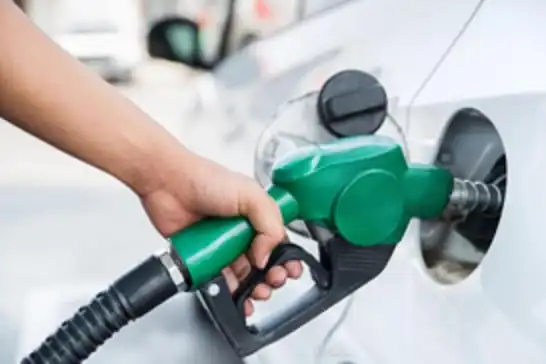
A decline in global oil prices is expected to be reflected in fuel prices in Türkiye, with sector sources forecasting reductions of around 3 Turkish lira per litre for gasoline and 4 Turkish lira per litre for diesel in the coming days.
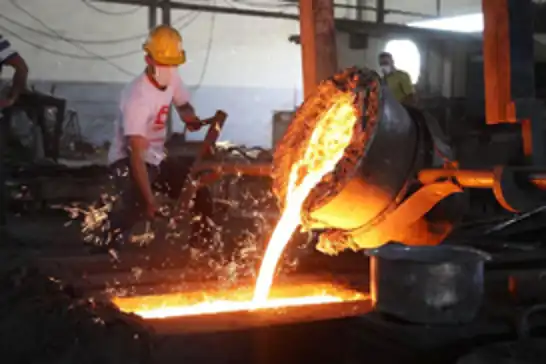
Türkiye's industrial production increased by 2.6% year-on-year in September 2026, driven by growth across the mining, manufacturing and energy sectors, the Turkish Statistical Institute (TurkStat) said on Tuesday.
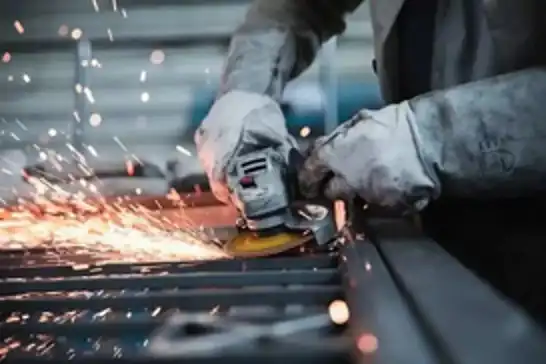
Türkiye’s services sector consumed a total of 485,413 terajoules of final energy in 2025, with electricity accounting for more than half of overall consumption, the Turkish Statistical Institute (TurkStat) said on Friday.