Top income group’s share falls slightly as income inequality eases in Türkiye
 13 oC
13 oC 
Güneşli

The share of the highest-income group in Türkiye’s total income declined marginally in 2025, while overall income levels rose sharply, according to the latest Income and Living Conditions Survey released by the Turkish Statistical Institute (TurkStat) on Friday.
The survey results, which reflect income data for the 2024 calendar year, show that the top 20% of households accounted for 48.0% of total equivalised household disposable income, a decrease of 0.1 percentage points compared to the previous year. Meanwhile, the share of the bottom 20% rose slightly to 6.4%, up by 0.1 points year-on-year.
In calculating income distribution statistics, household income is adjusted according to household size and composition to derive equivalised household disposable income.
Gini coefficient declines to 0.410
Income inequality, measured by the Gini coefficient, showed a modest improvement. The Gini coefficient fell to 0.410 in 2025, down by 0.003 points from the previous year. The coefficient ranges from 0, indicating perfect equality, to 1, indicating complete inequality.
As part of a new methodology introduced with the 2025 results, TurkStat also calculated the Gini coefficient for gross income, derived from administrative records before taxes and social security contributions are deducted. The Gini coefficient stood at 0.422 for gross income. When all social transfers were excluded, the coefficient rose to 0.473, while it declined to 0.420 when pensions and survivors’ benefits were included but other social transfers were excluded, highlighting the equalizing effect of social support mechanisms.
The S80/S20 ratio—comparing the income of the richest 20% to that of the poorest 20%—declined by 0.2 points to 7.5. The S90/S10 ratio, which compares the richest 10% to the poorest 10%, fell by 0.4 points to 12.9.
Household incomes rise sharply
TurkStat data showed a strong increase in household incomes. Mean annual household disposable income reached 662,414 Turkish liras in 2025, marking a 76.7% increase compared to the previous year.
Mean annual equivalised household disposable income rose even faster, increasing by 77.3% year-on-year to 332,882 liras, up from 187,728 liras.
By household type, one-person households recorded the highest mean annual equivalised disposable income at 418,025 liras, an increase of 194,166 liras from the previous year. This was followed by multi-person households without a family structure at 386,713 liras and one-family households at 338,164 liras. Extended-family households had the lowest average income at 264,413 liras.
Wages dominate income composition
Wages and salaries remained the largest component of total equivalised household disposable income, accounting for 49.7% of the total, an increase of 0.9 percentage points from the previous year. Entrepreneurial income followed with a share of 18.3%, though this declined by 2.5 points. Social transfers accounted for 18.2% of income, rising by 0.4 points.
Within entrepreneurial income, agricultural activities made up 15.6%. Pensions and survivors’ benefits constituted 89.3% of all social transfers, underlining their central role in household incomes.
Higher education graduates earn the most
Income levels varied significantly by education level. Higher education graduates earned the highest mean annual income at their main job, at 566,839 liras. This was followed by high school or equivalent graduates with 376,932 liras, those with less than high school education at 290,323 liras, and individuals with no formal school graduation at 183,900 liras.
Compared to 2024, the largest increase in main job income was recorded among higher education graduates, at 83.0%, while the smallest increase was observed among high school graduates, at 56.7%.
Construction sector leads income growth
By sector, the highest mean annual income at the main job was recorded in the services sector at 426,045 liras, while agriculture posted the lowest at 237,461 liras.
In terms of growth, the construction sector recorded the strongest increase in average income, rising by 79.0% year-on-year. This was followed by services at 75.8%, industry at 70.1%, and agriculture at 54.4%.
Employers top income rankings
Employers continued to earn the highest average income, with a mean annual income at the main job of 1,204,791 liras. Regular employees earned an average of 379,047 liras, self-employed workers 348,045 liras, and casual employees 186,682 liras.
The highest year-on-year income increase was seen among regular employees at 80.7%, while employers recorded the lowest increase at 49.7%.
Regional disparities persist
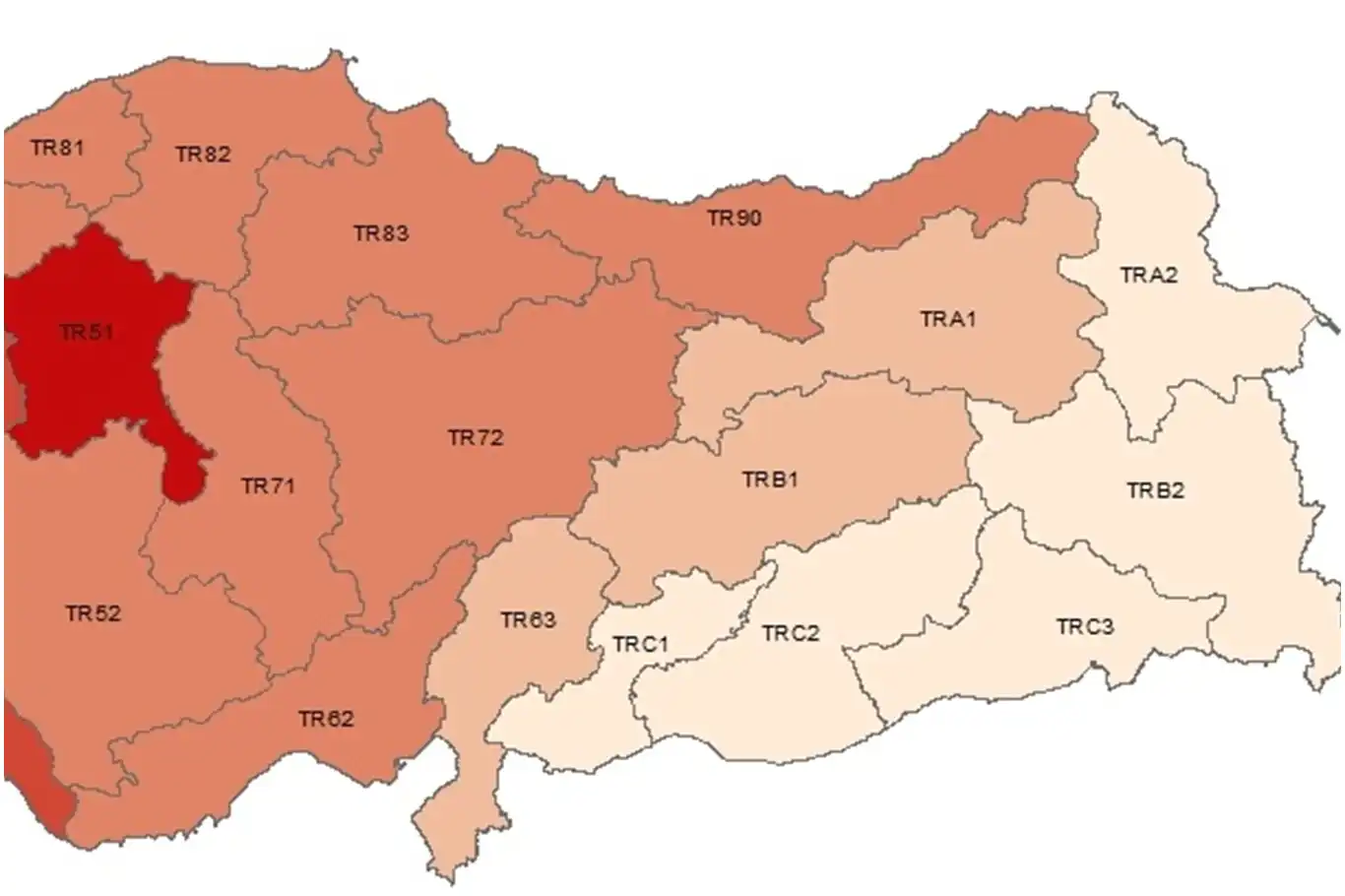
Significant regional disparities remained. Ankara (TR51) recorded the highest mean annual equivalised household disposable income at 449,618 liras, followed by Istanbul (TR10) with 434,929 liras and İzmir (TR31) with 405,896 liras.
The lowest income was observed in the TRB2 region, comprising Van, Muş, Bitlis and Hakkari, where mean annual equivalised household disposable income stood at 172,552 liras.
Income inequality also varied by region. While the national S80/S20 ratio was 7.5, the lowest inequality was recorded in TRB1 (Malatya, Elazığ, Bingöl, Tunceli) and TR42 (Kocaeli, Sakarya, Düzce, Bolu, Yalova) with ratios of 4.6. The highest inequality was observed in TR71 (Kırıkkale, Aksaray, Niğde, Nevşehir, Kırşehir) with a ratio of 8.5.
Income mobility and labor market trends
The survey also highlighted income mobility. In 2025, 58.9% of individuals in the lowest income decile and 68.1% of those in the highest decile remained in the same income group as the previous year. Nearly one in five individuals in the lowest decile in 2024 moved up by more than one decile in 2025, while 11.4% of those in the top decile moved down by more than one decile.
Labor market transitions showed improvement, with 38.7% of individuals who were unemployed in 2024 finding work in 2025. Meanwhile, 90.3% of those employed in 2024 remained in employment the following year, and 10.1% of individuals previously outside the labor force either entered employment or began seeking work in 2025.
Overall, TurkStat said the findings point to rising incomes, modestly improving income distribution, and continued regional and structural disparities across Türkiye’s economy. (ILKHA)
LEGAL WARNING: All rights of the published news, photos and videos are reserved by İlke Haber Ajansı Basın Yayın San. Trade A.Ş. Under no circumstances can all or part of the news, photos and videos be used without a written contract or subscription.

Gold prices surged to a new all-time high on Friday, marking the second record-breaking session in a single week, as investors continued to flock to safe-haven assets amid persistent global uncertainty, inflation concerns, and currency weakness.

Istanbul’s Sabiha Gökçen International Airport has set new passenger and flight records following the commissioning of its second runway, highlighting the airport’s rising importance as a regional and global aviation hub on the city’s Asian side.

Türkiye’s monthly average labour cost stood at TRY 45,777 in 2024, according to the latest Labour Cost Statistics released for the reference year.