NASA confirms massive new crater formed on Moon by 2024 impact
 13 oC
13 oC 
Güneşli

NASA has confirmed the discovery of a massive new impact crater on the Moon, created when a fragment of an asteroid or comet slammed into the lunar surface in 2024.
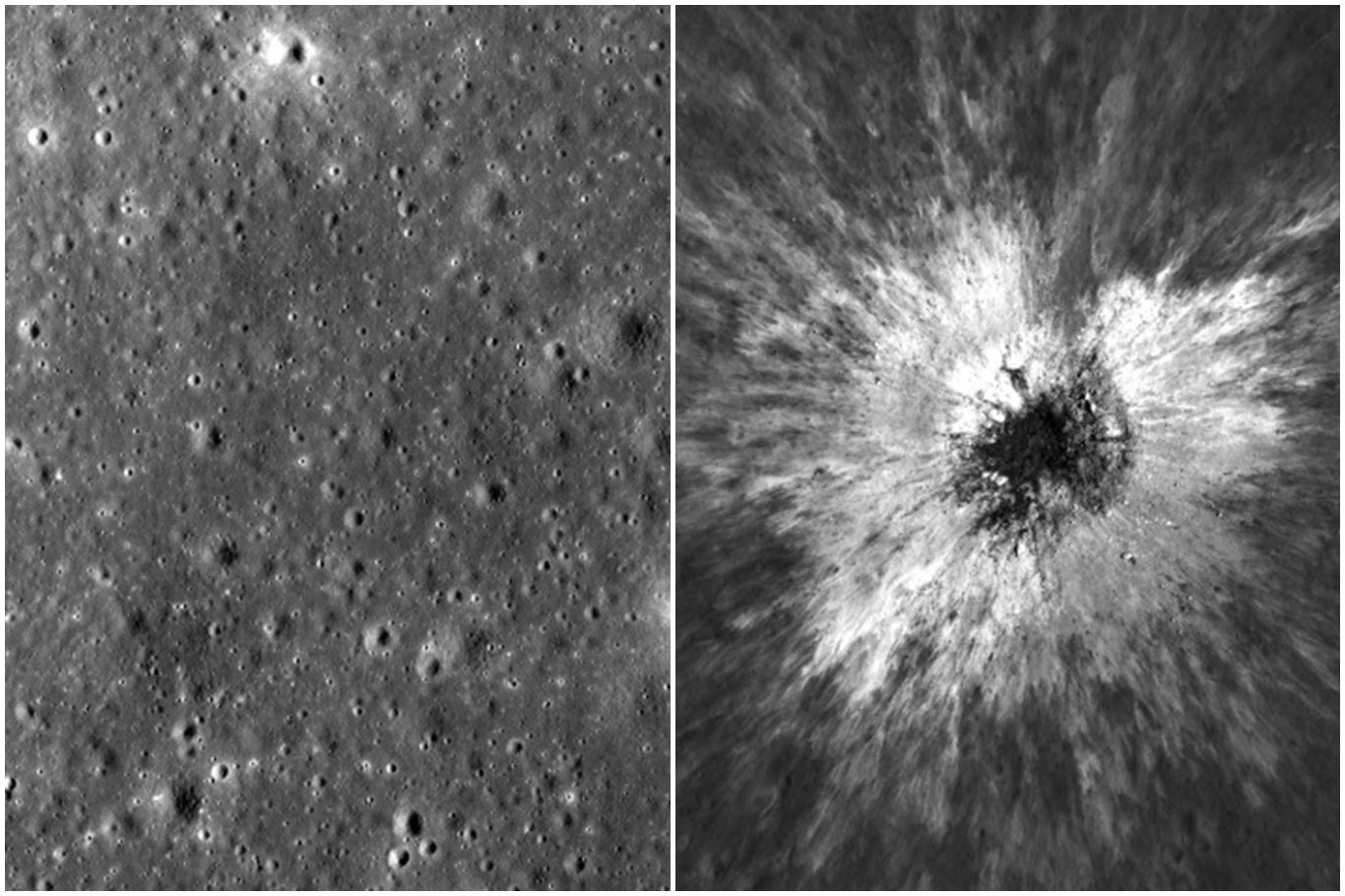
The crater, officially named McGetchin crater after pioneering lunar scientist Tom McGetchin, measures approximately 222 meters (728 feet) across and up to 43 meters (141 feet) deep. Its diameter is roughly twice the length of an American football field, making it the largest newly formed crater discovered during the lifetime of NASA's Lunar Reconnaissance Orbiter (LRO).
Scientists estimate that the impact occurred sometime between April 11 and May 22, 2024, when an asteroid or comet fragment, potentially comparable in size to a three- to six-story building, struck the Moon's surface. The event was not detected in real time by telescopes on Earth or in space.
The crater was discovered later when researchers analyzed images collected by NASA's LRO. In October 2025, LRO image-processing specialist Robert Wagner identified an unusually bright feature surrounded by a dark halo while comparing images of the lunar surface taken at different times. The pattern indicated that material had been violently excavated and scattered by a recent impact.
Researchers then compared older and newer observations to establish that the feature had not existed previously. Follow-up observations by LRO's instruments confirmed the crater and allowed scientists to study the effects of the impact in greater detail.
The discovery is particularly significant because impacts of this magnitude are considered rare. Scientists estimate that an impact capable of producing a crater of this size occurs on the Moon roughly once every century or even longer.
The impact also altered the lunar surface far beyond the crater itself. Observations from LRO's Diviner thermal instrument revealed a cold region roughly 6.4 kilometers (four miles) across surrounding the crater. At night, this area was found to be about 9 degrees Celsius (16 degrees Fahrenheit) colder than nearby terrain.
Scientists attribute the temperature difference to the impact disturbing and loosening the Moon's upper layer of soil, known as regolith. The less densely packed material does not retain heat as efficiently, allowing the surrounding surface to cool more rapidly after sunset.
The finding provides scientists with an unusually fresh example of how an impact reshapes the lunar surface. Unlike Earth, the Moon has no atmosphere, liquid water or active weather systems capable of rapidly eroding newly formed craters. As a result, impact features can remain preserved for extremely long periods.
The newly discovered crater could therefore serve as a natural laboratory for studying the immediate effects of asteroid and comet impacts, including how far debris is scattered and how impacts alter the physical properties of lunar soil.
Researchers say such observations are also relevant to future lunar exploration. NASA's LRO has been mapping the Moon in unprecedented detail since its launch in 2009, providing information used to study the lunar environment and identify potential locations for future robotic and human missions.
The discovery comes as activity around the Moon increases, with NASA and international and commercial partners preparing for expanded lunar exploration. Understanding how frequently impacts occur and how they modify the surface could help scientists assess risks to future spacecraft, rovers and lunar infrastructure.
The McGetchin crater demonstrates that, despite appearing geologically quiet, the Moon remains an active target for objects traveling through the solar system. A single impact can rapidly reshape the lunar landscape—and, in this case, leave behind a crater more than 200 meters wide that went unnoticed until scientists looked closely at the Moon's changing surface. (ILKHA)
LEGAL WARNING: All rights of the published news, photos and videos are reserved by İlke Haber Ajansı Basın Yayın San. Trade A.Ş. Under no circumstances can all or part of the news, photos and videos be used without a written contract or subscription.

A new report has warned of a potential “tidal wave” of so-called forever chemicals as manufacturers move to meet rapidly growing demand from the artificial intelligence (AI) industry.

Artificial intelligence company Anthropic said it has disrupted multiple malicious operations involving its Claude AI models, ranging from cyber-espionage and mass surveillance to attempts to use artificial intelligence in weapons development.

A former Colorado Bureau of Investigation forensic scientist has been sentenced to 10 years in prison after admitting to manipulating and falsifying DNA-related data, a scandal that has cast doubt on more than 1,000 criminal cases and triggered a sweeping review of forensic evidence across the state.