Canadian FM backs Palestinian self-determination, condemns Israeli settlements at UN
 13 oC
13 oC 
Güneşli

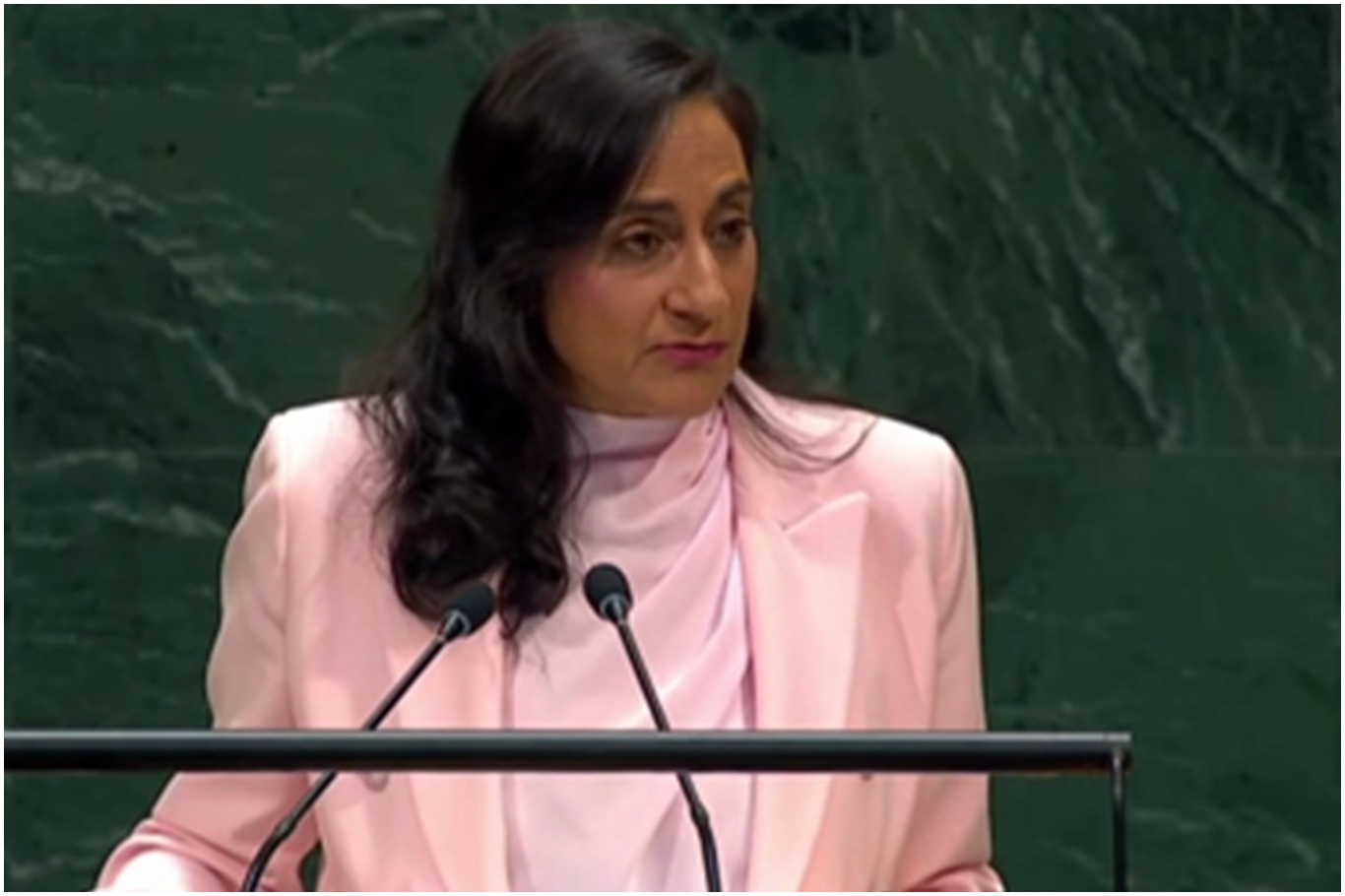
Canada’s Foreign Minister Anita Anand said Saturday that Palestinians have an equal right to self-determination and called for the establishment of an independent Palestinian state alongside Israel, while describing Israeli settlements in the occupied West Bank as illegal under international law.
Addressing the 81st session of the United Nations General Assembly in New York, Anand said Canada remained committed to a negotiated two-state solution and stressed that Palestinian statehood and self-determination could not be separated from efforts to achieve lasting peace in the region.
“Self-determination is a right to which both Israelis and Palestinians are entitled,” Anand said.
The minister said Canada supported the creation of a Palestinian state living alongside Israel “in peace, security, and dignity,” while maintaining that Israel’s right to exist was not in question.
Anand said Israeli settlements in the West Bank were “illegal under international law and an obstacle to peace,” and pointed to Canada’s announcement earlier this month that it intended to restrict trade in goods originating from Israeli settlements.
Canada, along with a group of European countries, announced on Sept. 8 that it intended to introduce or support restrictions on trade in settlement goods. The countries said settlement expansion and violence in the occupied West Bank were undermining the prospects for a two-state solution.
The Canadian government has also imposed sanctions on individuals and entities it says are involved in extremist settler violence against Palestinian civilians and their property.
Anand said Canada would continue providing humanitarian assistance to Palestinians in need.
In June, Canada announced an additional C$100 million in assistance for Palestinians in Gaza and the West Bank, bringing its total contributions to international assistance efforts in Palestine to more than C$500 million, according to Global Affairs Canada.
Anand’s remarks came as the Palestinian question remained a central issue during the UN General Assembly’s high-level week.
UN Secretary-General António Guterres said earlier this week that conditions necessary for an independent and viable Palestinian state were being “systematically erased” by settlement expansion, settler violence and other developments in the occupied Palestinian territory.
Guterres said Israeli settlements in the occupied Palestinian territory violate international law and warned that the expansion of the E1 settlement project could severely undermine the territorial continuity of a future Palestinian state.
The UN Human Rights chief Volker Türk similarly warned on Sept. 24 that continued settlement expansion and violence in the West Bank were threatening the prospects for a two-state solution and called for stronger international action to uphold international law.
The General Assembly has also taken steps to ensure Palestinian participation in the 81st session. On Sept. 17, member states voted 152-3, with four abstentions, to allow the State of Palestine to participate virtually in the high-level general debate.
Anand said Canada’s Middle East policy remained centered on a negotiated two-state settlement.
“The right of the Palestinian people to self-determination in a state of their own is also not up for debate,” she said.
She added that Canada would continue targeting Hamas and other groups it considers terrorist organizations, saying Hamas should have no role in governing Palestine.
At the same time, Anand said Canada would continue supporting humanitarian assistance for civilians affected by the conflict.
The minister’s remarks came after Canada joined an international meeting on the two-state solution during the UN General Assembly high-level week. Canada has been working with France, Saudi Arabia and the United Kingdom on efforts aimed at advancing the creation of an independent Palestinian state alongside Israel.
Anand also addressed wider Canadian foreign-policy priorities in her speech, including Ukraine, Arctic security, Iran, maritime security, trade diversification and reform of the multilateral system.
She said Canada intended to pursue what she called “values-based realism” while strengthening partnerships and reducing its dependence on any single international partner.
For the Middle East, however, Anand placed Palestinian self-determination, humanitarian assistance and opposition to Israeli settlement expansion among the key elements of Canada’s stated approach to the conflict. (ILKHA)
LEGAL WARNING: All rights of the published news, photos and videos are reserved by İlke Haber Ajansı Basın Yayın San. Trade A.Ş. Under no circumstances can all or part of the news, photos and videos be used without a written contract or subscription.
Iranian President Masoud Pezeshkian described the Mecca Defense Agreement signed by Saudi Arabia, Türkiye and Pakistan as a positive step toward Muslim unity while expressing deep distrust of Washington over stalled nuclear negotiations in an interview with Qatar-based broadcaster Al Jazeera.

At least 27 people were killed in two separate mass shootings in South Africa, police said Sunday, with gunmen targeting an entertainment venue near Johannesburg and another in a township outside Cape Town.

Four people were killed Saturday after a helicopter crashed and caught fire southeast of Montreal, Quebec provincial police said.