Portugal enforces public face-covering ban targeting Muslim women
 13 oC
13 oC 
Güneşli

Portugal has brought into force a law restricting face coverings in public spaces, introducing fines of up to 3,000 euros ($3,420) for people who cover their faces without a legally recognized justification.
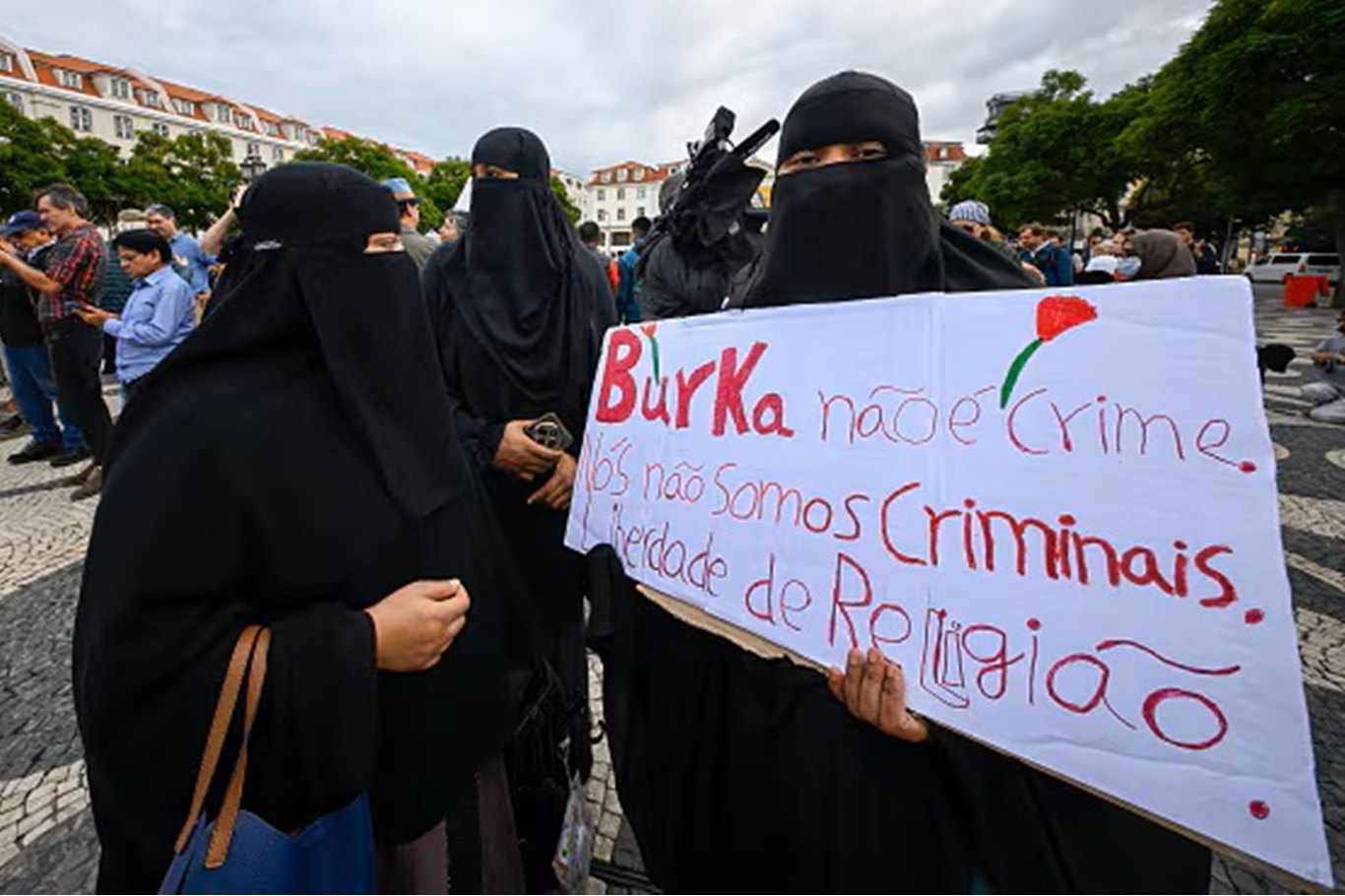
The legislation, which took effect Wednesday, has drawn particular attention because its parliamentary origins were explicitly linked to proposals targeting Islamic face veils, including the niqab and burqa worn by some Muslim women.
The measure was initially proposed by Chega, a right-wing Portuguese political party, and was approved by parliament after a contentious debate over religious freedom, individual rights and public restrictions. Contemporary reporting on the parliamentary vote described the legislation as specifically targeting Muslim women who wear face-covering garments for religious reasons.
Under the new law, people who cover their faces in public without an accepted justification can face fines of up to 3,000 euros. The legislation also makes it an offense to coerce another person into covering their face, punishable by up to two years in prison. Where the person subjected to such coercion is a minor, the penalty can be increased by one third.
The law defines public spaces broadly, including public roads, locations accessible to the public, facilities assigned to public services and places providing services generally available to citizens.
However, the legislation provides several exemptions. Face coverings remain permitted in aircraft, diplomatic and consular premises, places of worship and other sacred sites. Exemptions also apply for health, professional, artistic, advertising, security and weather-related reasons, as well as circumstances in which another law permits the covering of the face.
The legislation has prompted renewed debate over the balance between religious freedom and restrictions imposed on religious dress in Europe.
Supporters of the measure have argued that restrictions on face coverings are connected to principles such as personal freedom and equality. Critics, however, have argued that such laws disproportionately affect Muslim women and restrict the freedom to observe religious practices.
When parliament approved the bill, lawmakers from left-wing parties accused Chega of using the legislation to target foreigners and people of different faiths. The bill's parliamentary debate specifically focused on garments such as the burqa and niqab, despite the relatively small number of women in Portugal who wear such coverings.
The law therefore places Portugal among a group of European countries that have adopted restrictions on face-covering garments, adding to a wider European debate over Islam, religious freedom, women's rights and the limits of state regulation of religious expression.
For Muslim communities, the measure is likely to remain a significant point of discussion because it directly affects a form of religious dress worn by some Muslim women and raises broader questions about whether governments should restrict religious practices in public spaces.
Portugal's new restrictions come amid a wider political debate in Europe over immigration, Islam and the place of religious minorities in increasingly diverse societies. (ILKHA)
LEGAL WARNING: All rights of the published news, photos and videos are reserved by İlke Haber Ajansı Basın Yayın San. Trade A.Ş. Under no circumstances can all or part of the news, photos and videos be used without a written contract or subscription.
Russian drone strikes killed two people and injured at least 43 others in Kyiv on Wednesday, damaging residential and commercial buildings, railway infrastructure and other civilian facilities as waves of drones targeted the Ukrainian capital.

At least 11 people were killed and three others wounded when unidentified gunmen opened fire at a residential property in South Africa’s eastern KwaZulu-Natal province, local media reported Wednesday.

Afghanistan's Finance Minister Mullah Mohammad Nasir Akhund held an online meeting with customs officials, urging them to improve services for the public and traders while strengthening oversight of customs operations.