Ethiopia’s role in Sudan crisis sparks regional security concerns
 13 oC
13 oC 
Güneşli

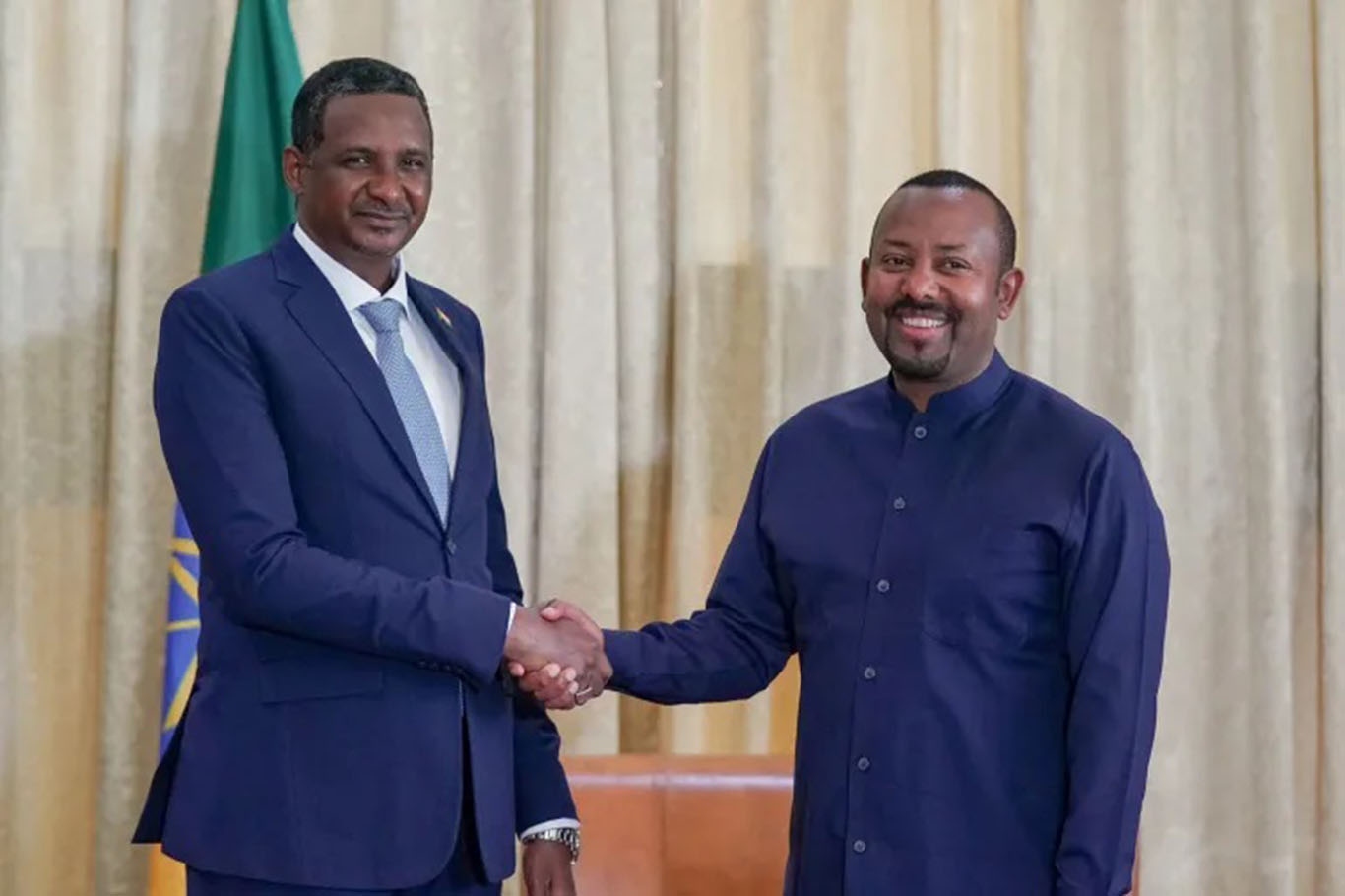
The war in Sudan is no longer viewed merely as an internal conflict between the Sudanese Armed Forces (SAF) and the Rapid Support Forces. Increasing military, political, and logistical indicators suggest that Ethiopia, under Prime Minister Abiy Ahmed, has emerged as one of the most influential regional actors shaping the course of the conflict.
For decades, relations between Sudan and Ethiopia have extended beyond conventional diplomacy. Shared borders, tribal ties, armed movements, and competing security calculations have historically intertwined the affairs of both countries.
In the early 1990s, Sudan reportedly provided indirect backing to the Tigray People's Liberation Front during its struggle against the regime of Mengistu Haile Mariam. The eventual rise of Meles Zenawi was at the time viewed by Khartoum as a strategic gain for Sudanese security interests, particularly because Addis Ababa had previously supported separatist movements in South Sudan.
Today, however, the regional equation appears reversed. Sudan, once influential in Ethiopia’s internal power balance, now finds itself confronting growing foreign interference on its own soil. Ethiopia is increasingly seen not merely as a mediator, but as a direct actor affecting developments on the battlefield.
Why is Ethiopia moving closer to the RSF?
In recent months, the Sudanese army has openly accused Ethiopia of supporting the RSF.
Following clashes in the Blue Nile region, Sudanese military officials alleged that RSF fighters crossed into Sudan through Ethiopian territory, that certain attacks were coordinated from inside Ethiopia, and that armed elements received training in camps located across the border.
Particular attention has focused on the al-Kurmuk area, near the Ethiopian frontier. The region holds major strategic significance because control there provides influence over eastern Sudan and the Blue Nile corridor.
International reports have also intensified scrutiny. Investigations published by Reuters cited claims that RSF-linked training activities were taking place in Ethiopia’s Benishangul-Gumuz region. Satellite imagery assessments linked to research institutions at Yale University reportedly identified unusual military activity near the Sudan-Ethiopia border.
Military movements around Assosa Airport, including newly constructed hangars, drone-compatible infrastructure, and intensified logistical operations, have also drawn attention among regional observers.
Analysts argue that one reason Ethiopia may prefer closer ties with the RSF is its search for a more flexible partner than the Sudanese army. Khartoum has adopted increasingly hardline positions toward Ethiopia on border security disputes, the al-Fashaga issue, and the Grand Ethiopian Renaissance Dam (GERD).
The RSF, by contrast, is viewed as a decentralized force with strong influence in border regions and greater openness to cooperation with external actors.
Al-Fashaga dispute pushed relations toward confrontation
One of the most important drivers of tension between Sudan and Ethiopia is the disputed al-Fashaga border region.
The fertile agricultural area has long remained contested. Sudan bases its territorial claims on the 1902 border agreement, while Ethiopia has sought to establish de facto influence there for years.
In 2020, while Ethiopia was heavily engaged in the Tigray conflict, Sudanese forces moved to reassert control over parts of the region — a development that reportedly caused deep concern in Addis Ababa.
The dispute is not limited to territorial claims alone. Al-Fashaga is strategically important due to its agricultural value, water access, security routes, and smuggling corridors.
Sudan’s growing military presence in the area is widely viewed as one of the factors that hardened Ethiopia’s policy toward its western neighbor.
GERD and the struggle over the Nile
Another major source of tension is the Grand Ethiopian Renaissance Dam, known regionally as the Hedasi Dam.
The massive dam project on the Blue Nile has triggered years of disputes between Ethiopia and Egypt. Sudan has at times attempted to maintain a balancing position between the two sides.
However, expanding military and diplomatic cooperation between Sudan and Egypt in recent years has reportedly alarmed Ethiopian officials. Joint military exercises, security agreements, and political coordination have increasingly been interpreted in Addis Ababa as strategic threats.
This has reinforced assessments that Ethiopia sees closer relations with the RSF as a way to counterbalance Sudan’s army and limit Egyptian influence in the region.
Red Sea ambitions shape Addis Ababa’s strategy
Ethiopia’s growing involvement in Sudan is also closely linked to its long-term ambition of securing access to the Red Sea.
As a landlocked nation, Ethiopia has for years sought broader access to regional ports. Prime Minister Abiy Ahmed has recently framed Red Sea access as an issue of “national survival.”
Addis Ababa’s controversial port agreement with Somaliland significantly altered regional dynamics. In response, Somalia moved closer to Egypt, while Eritrea adopted a more confrontational posture toward Ethiopia.
These developments have contributed to the emergence of a new regional axis opposed to Ethiopia’s expanding ambitions.
Sudan now stands at the center of this geopolitical struggle due to its strategic position linking the Nile Basin, the Red Sea, and the Horn of Africa.
Observers therefore argue that Ethiopia’s efforts to expand influence inside Sudan are not solely about the civil war itself, but also about containing Egypt’s growing regional footprint.
Domestic crises are driving a harder foreign policy
Ethiopia has also been grappling with severe internal challenges.
Although the Tigray war formally ended, ethnic tensions and instability remain unresolved. Continued unrest in the Amhara and Oromo regions, combined with economic hardship, inflation, foreign currency shortages, debt pressures, and unemployment, have increased pressure on Abiy Ahmed’s government.
According to regional analysts, Addis Ababa may be pursuing a more assertive foreign policy in part to divert attention from mounting domestic crises.
The GERD dispute, Red Sea ambitions, and Ethiopia’s growing role in Sudan are increasingly viewed as interconnected elements of this broader strategy.
Sudan’s war is becoming a regional confrontation
The conflict in Sudan has evolved far beyond a struggle between the army and the RSF.
Today, it increasingly reflects a wider regional contest involving Egypt, Eritrea, Ethiopia, the United Arab Emirates, and other actors competing for influence across Northeast Africa and the Horn.
Claims surrounding Ethiopian support for the RSF are therefore seen as part of a much larger geopolitical rivalry.
Developments along the Blue Nile corridor in particular have fueled speculation that Ethiopia seeks to establish long-term influence in eastern Sudan.
This trajectory carries risks not only for Sudan, but for the entire Horn of Africa. A deeper Sudanese conflict could intensify indirect confrontation between Egypt and Ethiopia, while also increasing the likelihood of more active Eritrean involvement.
Analysts warn that Ethiopia’s current approach could produce several possible outcomes: securing long-term influence through RSF-controlled territories, triggering wider regional military escalation, or contributing to the fragmentation of the Sudanese state itself.
All of these dynamics demonstrate that the Sudan war is no longer a purely domestic crisis. It is increasingly becoming the focal point of a broader regional power struggle reshaping the Horn of Africa. .(ILKHA)
LEGAL WARNING: All rights of the published news, photos and videos are reserved by İlke Haber Ajansı Basın Yayın San. Trade A.Ş. Under no circumstances can all or part of the news, photos and videos be used without a written contract or subscription.

Muslims across the world are preparing to observe the Day of Ashura, one of the most significant occasions in the Islamic calendar, which falls on the 10th day of Muharram, the first month of the Islamic lunar year.

Rising public discontent and large-scale street protests in recent weeks signal that opposition to President Kais Saied’s rule may be reaching a critical new phase.
Today marks 78 years since the Palestinian people were plunged into the Nakba (the Catastrophe)—a systemic, ongoing campaign of forced migration, brutal occupation, and massacres that tore Al-Quds and the wider homeland from its rightful owners.