Scotland, Wales and Northern Ireland leaders unite in call for constitutional change
 13 oC
13 oC 
Güneşli

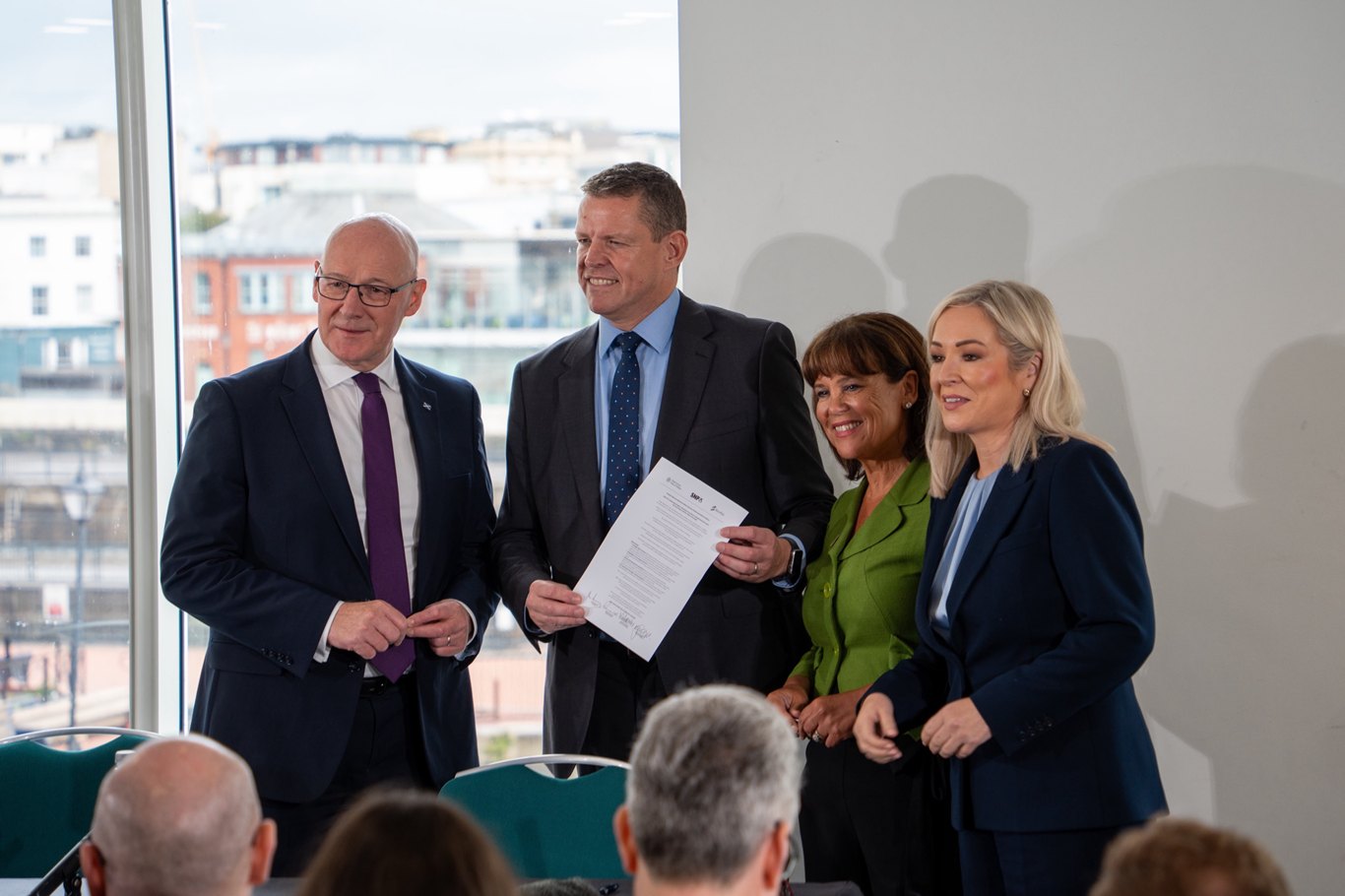
The leaders of Scotland, Wales and Northern Ireland have signed a landmark declaration calling on the UK government to prepare for possible constitutional change, in an unprecedented show of cooperation among the three nations' nationalist movements.
Scottish First Minister and SNP leader John Swinney, Welsh First Minister and Plaid Cymru leader Rhun ap Iorwerth, and Northern Ireland First Minister and Sinn Féin vice-president Michelle O'Neill signed the agreement in Cardiff on Monday. The declaration says the political landscape across the UK and Ireland “is changing” and asserts the right of each nation to determine its own future through democratic means.
“Our nations have the right to self-determination,” the leaders said, calling on the British government to “prepare for, plan and facilitate constitutional change in each jurisdiction.”
They also argued that no Westminster government should be able to block democratic demands for constitutional change.
The agreement marks a significant development because, for the first time since devolution began in 1997, Scotland, Wales and Northern Ireland have first ministers whose political parties are committed to ending their territories' constitutional ties with the UK.
The declaration nevertheless acknowledges that the three territories face different constitutional circumstances and that each will determine its future according to its own political conditions and timetable.
Push for closer European ties
The leaders said they believe the future of their nations “belongs in” the European Union, arguing that Brexit has damaged their economies and reduced opportunities for their populations.
They pledged to strengthen cooperation in areas including trade, investment, culture, energy and relations with Europe.
Swinney said the three parties share the belief that people in their respective nations should be able to shape their own futures.
“At this pivotal moment of constitutional change, we will deepen our partnership,” he wrote on X.
The agreement comes as nationalist parties seek to turn growing political cooperation into greater pressure on Westminster.
For Scotland, the central demand remains independence. Scotland voted against independence in the 2014 referendum, with 55% voting to remain in the UK. The SNP continues to support another referendum, although the UK government has resisted calls for a second vote.
In Wales, Plaid Cymru's independence campaign has traditionally attracted less support than Scottish nationalism, but the party has increasingly placed Welsh sovereignty at the center of its political agenda.
Northern Ireland presents a different constitutional route. Under the 1998 Good Friday Agreement, a referendum on Irish unity can be held if the UK government believes there is likely to be a majority in Northern Ireland in favor of leaving the UK and joining a united Ireland.
Trump intervention adds momentum
The Cardiff declaration came just days after US President Donald Trump publicly backed the idea of a united Ireland during his visit to Dublin.
Speaking alongside Irish Taoiseach Micheál Martin on Saturday, Trump said he would “love” to see Ireland reunified and suggested that unification would happen eventually and “may as well happen now.”
Trump repeated his support on Sunday, describing Irish reunification as a natural development while declining to express a position on Scottish independence.
His comments prompted a swift response from London. The UK government has maintained that there is currently no sufficient public support for another referendum on Northern Ireland's constitutional status and that such a vote will not be held unless that situation changes.
The intervention also highlighted the growing divergence between unionists and nationalists in Northern Ireland. Unionist politicians have stressed that Northern Ireland's constitutional future must be decided by its people rather than by politicians in London, Dublin or Washington.
‘Westminster's time is coming to an end’
O'Neill said ahead of Monday's meeting that the political landscape was “very much changing” and that Irish unity was increasingly “on the table.”
The three leaders argued that their cooperation represents more than a symbolic alliance.
“What unites us is a determination to ensure that the voices of our nations are heard, that our people have the opportunity to thrive, and that cooperation between Scotland, Wales and Ireland can be strengthened,” their declaration said.
They also delivered their strongest political message to Westminster, saying that for people watching across the UK and internationally, there could be “no clearer sign that Westminster's time is coming to an end.”
The UK government, however, has rejected the suggestion that the declaration signals an imminent break-up of the United Kingdom. A government spokesperson said the UK is “at its best” when its nations work together rather than pursue division, while Prime Minister Andy Burnham has emphasized economic priorities over further constitutional referendums.
The Cardiff agreement therefore does not itself trigger any referendum or alter the constitutional status of Scotland, Wales or Northern Ireland. Its significance lies instead in bringing the three nationalist movements together at a moment when questions over the future of the United Kingdom are becoming increasingly prominent. (ILKHA)
LEGAL WARNING: All rights of the published news, photos and videos are reserved by İlke Haber Ajansı Basın Yayın San. Trade A.Ş. Under no circumstances can all or part of the news, photos and videos be used without a written contract or subscription.

Yemeni armed forces said they carried out a large-scale missile and drone operation targeting Saudi military facilities at King Khalid Air Base in Khamis Mushait, in southern Saudi Arabia.

The death toll from Israel’s ongoing genocidal war on the Gaza Strip has risen to 73,786 Palestinians, while 174,771 others have been injured since October 7, 2023, according to Palestinian medical sources.

More than 2,000 people have fled Yemen for neighboring Djibouti as fighting between Houthi forces and government troops intensifies, amid a sharp escalation in displacement, the International Organization for Migration (IOM) said Sunday.